


Innovation Fund

The Innovation Fund provides investments in research infrastructure across the full research spectrum, from the most fundamental investigations to applied research and technology development, and across all research disciplines from natural sciences and engineering, life sciences and health, to social sciences, humanities and the arts. These investments help keep Canada competitive, resilient and ready to tackle complex national and global challenges. Through this competition, we will invest in research environments that are equitable, inclusive and equipped to build Canada into the world’s leading hub for science and innovation.
Status: The 2027 Innovation Fund competition is now open. The deadline to submit notices of intent is September 29, 2026.
Key document: 2027 Innovation Fund competition call for proposals
What does an institution need to do before applying?
To participate in any of our funding competitions, you must first make sure your institution is eligible to apply for funding, has signed an institutional agreement and that you have an account on our CFI Awards Management System (CAMS).
Find out how to prepare to apply
What is the process to apply?
Follow the steps below and consult the call for proposals for complete instructions on how to apply.
Step 1: Submit a notice of intent
Submit a notice of intent if your institution plans to seek funding through this competition.
We will use notices of intent to:
- Identify what expertise is needed to assess each proposal
- Recruit committee members
- Ensure that the requested infrastructure is eligible.
Submit your notice of intent in the CFI Awards Management System (CAMS)
We will publish a list here of the notices of intent we receive. The list will include short project summaries. We encourage institutions with complementary projects to consider potential collaborations or multi-institutional initiatives, where appropriate.
Step 2: Submit a proposal
Consult the call for proposals for detailed instructions on how to submit a proposal.
Submit your proposal in the CFI Awards Management System (CAMS)
What do research institutions need to do regarding research security when they apply for CFI funding?
Institutions applying for CFI funding have research security obligations at the time of application under both the Government of Canada’s National Security Guidelines for Research Partnerships and the Policy on Sensitive Technology Research and Affiliations of Concern (STRAC).
Find out what your institution needs to provide with proposals to the 2027 Innovation Fund competition to meet those requirements.
Where can I find out more?
Watch the video or consult the slides of our recent information session to find out more. A frequently asked questions section will be added shortly. Please check back soon.
Information session for the 2027 Innovation Fund competition
June 2026
Note: This transcript was automatically generated and may contain inaccuracies.
Introduction
All right, let's get this started since we have a lot of content to get through. Hello, good afternoon for those of you who are in the same time zone as me. If not, good morning or good evening. Thank you for joining us today. Welcome to the 2027 Innovation Fund information session for applicants. We've had over 400 people registered for this webinar, so we're very pleased to see the interest in the competition. My name is Alex. I'm a senior programs officer here at the Canada Foundation for Innovation, and I'll be your host today. Over the next hour or so, I'll walk you through some key aspects of the competition. To be very clear, though, for anybody worried, all of the information we're going to be discussing here today can be found in our call for proposals. There's nothing new. There's nothing secret here. This session will just essentially allow us to highlight some of the key elements, some of the changes, as well as provide an opportunity for the community, you guys, to ask us some questions directly.
Housekeeping
1:56
So before we get started, just a few housekeeping items. You may have noticed that we've disabled the chat. So during the presentation, we invite you to use the Q&A function to submit any questions you might have. I'm joined by our excellent team in the background. They'll be monitoring and answering your questions throughout the session, so don't hesitate.
The Q&A will be moderated, however, which means you won't see your questions appear publicly until they've been published by the team. So just if you don't see it right away, no need to spam. Give the team a moment or two to review and write an answer to your question. If you prefer to ask your questions verbally, there will be a dedicated Q&A period, sorry, at the end of this presentation. Of course, whether verbally or in writing, you're always welcome to ask your questions either in French or in English. So for those who are interested in hearing all of the information we're about to go through today in the other official language, we will be hosting the same webinar again tomorrow in French. And the last little housekeeping note for today, the session is being recorded. We will be sharing the slides for the session, the recording of this webinar, as well as a frequently asked questions document in the coming weeks after the webinar. So feel free to share this with other people who might not have been able to be here or if you want to watch it again yourself. In case this makes you nervous though that we're going to be publishing this, don't worry, if you do speak up during the Q&A session at the end, it will not be shared publicly. We're only going to be sharing the informational part. The Q&A session will not be made publicly available. The Q&A session might inform the content of the frequently asked questions document, so in that way the whole community can benefit your questions, but we won't be airing it out publicly.
Agenda
2:27
Okay, today's agenda. We'll start with the competition objectives and budget, and follow it up with the timeline and some of the fund's key features. Then we'll move through the application and the review process, and then we'll close with some helpful resources and some time for questions.
Objectives & budget
2:44
So let's get into it with the competition objectives and the budget. So the Innovation Fund is designed to support projects that meet our three main competition objectives, which are to strengthen our researchers' abilities to excel and compete internationally, build sustainable research capacity, and generate meaningful and impactful benefits for Canadians. These are the central objectives of the competition and inform the assessment criteria we'll touch on later. In terms of funding, the CFI will invest up to $325 million in infrastructure, covering up to 40% of a total eligible project cost. As per usual, applicants are expected to leverage additional funding from other partners to cover the remaining 60%. Typically, this includes provincial funding, institutional funding, funding from industry or other granting agencies. And through our infrastructure operating fund, we continue to grant 30% of the CFI funded value towards operating and maintenance costs, meaning an additional $97.5 million or up to $97.5 million will be provided through this competition.
Important dates
3:47
Now, if we look at the timeline, so the call for proposal was launched on June 3rd. The next key milestone is the deadline to submit your notice of intent, which is on September 29th, followed by the full proposal deadline on February 2nd. The review process will take place between the months of March and October 2027, culminating with funding decisions by our board of directors in November 2027.
Key features
4:11
So if we go through some of the key features here. So we've continued with the three streams that were introduced in the previous competitions. So when you go to apply, you'll have to select which stream you're applying to. Since each stream has its own focus and slightly modified assessment framework, that this choice is rather important. So stream one is your traditional stream is open to all disciplines and all projects. Stream 2 is dedicated to social sciences, humanities, and the arts. So proposal submitted to this stream must have as their primary field of research something in the sciences, humanities, and arts. Or sorry, social sciences, humanities, and arts, to be clear. Stream 3 supports the creation, renewal, or upgrades of core facilities. Key here is that all of the requested infrastructure for any project submitted to the third stream must be housed in and managed by a core facility. An important point to emphasize since we do get this question a bit is that there's no predetermined allocation of funding across these different streams.
To which stream should I apply?
5:09
So as I mentioned, choosing the right stream is a critical step. So carefully review the definitions for each stream and the respective assessment criteria to ensure that your project clearly aligns with whatever stream you choose. We've provided this flow chart in the call to help guide applicants in their choice, and I'll guide you through it now. So the first critical step you're going to ask is if your project is mature enough to meet the deadlines for award finalization and completion that we've set out in the call and we'll actually touch on those in a moment. If the project is mature, great. Moving on. If it's not, perhaps may I wait for the next competition. Second question to ask yourself, is all of the infrastructure I'm requesting going to be housing a core facility and serve a variety of research programs? If yes, then we're going to stream 3. If it's not, then you can ask yourself, okay, is the field of research within the social sciences, humanities and arts? If yes, great, stream two. If not, stream one. And if ever you're in doubt, please reach out to your research office or the CFI for guidance on which stream to choose.
What is a core facility?
6:10
Now, we've talked about core facilities a little bit, so we want to take a moment to clarify what we mean by a core facility. So a core facility typically provides shared infrastructure, or sorry, shared access to resources that are generally too complex or costly for individual researchers to maintain. This can include things like specialized equipment, expertise, services or analysis, and training. Moreover, these core facilities are expected to be broadly accessible, serve a variety of research programs, be formally recognized by their institution, have a defined, sound, and dedicated governance and management structures as well as personnel. Importantly, in the context of the innovation fund, Core facilities cannot be predominantly focused on computing infrastructure. So a core facility that is just computing infrastructure is not eligible to request funding through this competition.
7:01
Given that we've received a lot of questions about our core facility stream, I want to take a moment here to hopefully preemptively address some of those common questions. So firstly, core facilities can be distributed across multiple sites and institutions. They still have to be all considered cores. It all still has to go in a core facility. but it can be distributed. Secondly, a core facility funded through the CFI's major science initiatives fund, so our MSI fund. So a core facility that's funded through the MSI can submit a project to this competition. The only caveat is that they cannot request funding for the expanded personnel costs that are allowed through stream 3, since these costs are already eligible under their MSI funding.
Thirdly, though, as I mentioned, core facilities that are predominantly focused on computing infrastructure are not eligible, you can still request ancillary or complementary computing infrastructure through this through the Stream 3 funding. Fourthly, a core facility director can be a team leader, meaning they can be the one to create or submit a project. The only requirement is that the individual who's leading or submitting the project be affiliated with the administrative institution. This affiliation requirement does not apply to any co-leads or other team members that might be added to the project. So in short, yes, a core facility director can submit a project, can lead a project. The only consideration is they have to be affiliated with the administrative institution. The formal recognition of a core, so what is a core? Whether you are you formally a core is left within the institution, within the hands of the institution. So talk to your research office, talk to your institution. The CFI is not the one who makes that determination. And since we're on the general topic of frequently asked questions about cores, I want to take a moment to mention two additional things that are other kind of common themes that have come up. First, as you may have noticed in our definition of what is a core, and as we're going to see a little bit later on in the assessment criteria, Stream 3 proposals are expected to demonstrate impact through a range of research activities. So we don't expect Stream 3 proposals to be centered on a single research project. So this notion of serving a large variety of research programs can be met, obviously, in a variety of different ways. For example, a facility can support multiple disciplines, so they can just be
Be truly, extremely multidisciplinary, or it can be that you're supporting an exceptionally broad user base within a slightly more narrower focused set of disciplines, so ultimately, always up to the applicants to determine the best way to demonstrate that they've met the assessment criteria, but to be very clear for stream three. The expectation is that there's impact through a range of research activities. And second, new core facilities are eligible. So as I mentioned before, as with any submission, you still demonstrate how you meet the assessment criteria. And of course, how you go about that might change on the approach or your approach might differ based on the maturity of your core. So for example, in stream 3, we ask that applicants describe the current or planned user base. So because we say planned, this implies that an established user base is not required. But if you were to request funding for a new core, you would still have to demonstrate a credible, justified or clear rationale for the anticipation user demand, your planned users. So new facilities are eligible. You just have to maybe take a different approach to justifying how you meet all the assessment criteria.
Key features (cont.)
10:22
So if we move on from cores to project readiness. So as I've mentioned a few times, we've talked about mature projects. So project readiness is an important consideration. Submitted projects should demonstrate a clear ability to become operational and achieve impacts within a reasonable time frame. So to be specific, projects funded through this competition are expected to be finalized within nine months of the funding decision and be completed. And by completed, we mean having submitted your final financial report within the timelines relevant to the size of the project. So you'll see in the table here. Depending on the size of your project, how much money you're requesting, that deadline is, can be a little earlier or a little later. Projects should be of an appropriate maturity. And if there's doubt about the ability of a project to be completed within these timeframes, might be advisable to wait until the next competition. There's also a minimum financial threshold. So the CFI contribution must be equal to or greater than $400,000. Since the CFI typically funds about 40% of a project, this means that the total project costs are usually going to be at least $1,000,000.
11:30
Apologies there. So here we wanted to highlight a few eligible personnel costs. To be clear, these are just a few examples of eligible costs and don't represent an exhaustive list, an exhaustive list. For a more thorough description of all eligible costs, consult our policy and program guide. So the first and third bullet point here that you see are not newly eligible costs, but they are still fairly new eligible cost categories overall for the competition. So we want to highlight them here again for anyone who might be unfamiliar with the change. So the first bullet point, the personnel support for databases continues to be an eligible capital cost for all streams. So right here, We recognize the importance of digital infrastructure, as well as their dynamic nature, which might require regular updates or management. So, continues to be eligible. Same with the third bullet point. So, Stream 3 continues to have access to a unique cost category intended to cover the salaries of technical and scientific personnel responsible for the general operation and maintenance of the core facility infrastructure. Same as the last competition, we're continuing with that. What is new to this competition is the expansion of eligible personnel costs to include what we call community interface personnel. So that's the second bullet point you see on the slide here. These are salary costs for individuals involved in the design and development of partnerships and community networks. These costs are eligible for all proposals which have their primary field of research in the social sciences, humanities, and arts. So as a final note here, a reminder that eligible costs, including personnel costs, can be incurred as early as November 1st, 2025, and as late as the relevant deadline to submit your final financial report. So as we saw earlier, that final date will vary based on the size of your project.
13:13
One another section that was new this year. So Canada has developed a defense industrial strategy, making research in defense and dual use technologies a timely topic. So here at the CFI, we always try to anchor each innovation fund in the current national and international context. So that's why in the call, we've identified some thematic areas that are particularly relevant for today. In alignment with this strategy and in pursuit of developing Canadian capacity, we encourage applicants to consider partnering with federal initiatives and organizations as applicable and relevant to your project. As for the CFI, what these collaborations mean is that the CFI will work with the Department of National Defense, DND, to help them identify projects that may be of interest to them. Practically, DND may identify projects of interest to them based on the public NOI information. And after obtaining appropriate permissions from institutions and researchers, the CFI might share the relevant NOIs, full proposals, and expert committee reports for those projects of interest. And we may also invite DND representatives to observe the relevant expert committee reviews. At their discretion, DND may contact applicants directly about their projects. Based on the questions we've received from the community about this new topic or this new language, I should say, in the call, the most important thing I want to stress here is that the competition budget, the assessment criteria, and the review process all remain the same. So regardless of your project's alignment, with defense or dual use technologies or collaborations with those federal agencies we mentioned. There's no fast tracking or prioritization or funding set aside for these types of projects. No change in the budget assessment criteria or review process.
14:57
So some more additional language we've added to the call. So we recognize that research excellence includes strengthening indigenous self-determination, leadership and research capacity. So in the call, you'll notice we've taken some space to describe what we mean by indigenous research. I've summarized and paraphrased it here to mean research that is conducted by, with, or grounded in First Nations, Metis, or Inuit communities and their knowledge systems. It requires respectful and meaningful engagement and must respond to community needs and priorities. So we provide this definition because, as you'll see a little bit later in the presentation, We ask applicants to identify if their proposals involve indigenous research. So this definition provides a framework for you to be able to answer that question. This question is important to us because it helps us to guide our recruitment of the review panel by ensuring that there are members with the appropriate expertise and in indigenous research, where relevant to a proposal.
Application process
15:50
All right, so those were the key features. So now we're going to jump into the application process. It's the most technical part of the webinar. So the application process has two stages. Both of these steps are managed through our CFI awards management system, CAMS, and you should already be able to access the NOI form through our system. So the first stage of applying is our notice of intent, or NOI, where we gather basic high-level information about your project. These NOIs are not evaluated, but do have two primary purposes. Firstly, an administrative purpose that includes things like confirming your stream eligibility, respective envelope allocations, things like that. And secondly, and most importantly, the NOI guides our initial recruitment efforts. This means the information you provide in your NOI is critical in positioning the type of expertise required for review, and therefore impacts who we start to recruit to review your proposal. The second stage of the application process is the submission of your full proposal. It's important to note here that access to your full proposal module will only be granted after we've completed our administrative review of the NOIs. So don't panic if you submit your NOI and don't immediately have access to your proposal module. We work to complete our admin review as quickly as possible, but there's a bit of a turnaround time between the submission deadline and access to your proposal module. You should receive a notice directly from CAMS once the NOI review has been completed and we've granted access to the proposal module.
Institutional envelopes
17:20
So in the competition, we use what we call institutional envelopes to control the volume of proposals that are submitted and maintain an approximate 30% success rate overall. Our primary aim by limiting the volume of proposals is to reduce reviewer and applicant burdens. So these envelopes fix the upper limit of CFI funding that institutions can submit. or request through the competition. And these envelope amount do vary a little bit by institution, so the details of your specific institution can be found in the last page of the call. It's important to note at the NOI stage, institutions are allowed to exceed their envelope limits by about 10%, but at the proposal stage, the submissions must adhere to the limits set by the envelope. This additional 10% at the NOI is to allow for a little bit more flexibility earlier in the process when institutions and researchers might still be finalizing their submission portfolios. So you may have also noticed in the call that we've added some new language around envelope sharing for multi-institutional projects. So though the expectations outlined by this new language are not new to our process, we have made this clear in the call this time around. So we wanted to highlight it here. In short, this applies to projects that have a collaborating institution that is contributing a portion of their envelope. In these circumstances, we ask that the envelope contribution of the collaborating institution be proportional to the value of the infrastructure we'll house, or to its scientific contribution to the project. Scientific contributions is a little broad, but it can mean things such as bringing on unique expertise or translating outputs to research, research outputs to industry.
Envelope exemptions
18:58
So now that we've talked about the envelopes, we can get into the exemptions to these envelopes. So here by exemption, we mean projects or project value requests that are not counted against the envelope allocation of an institution. There are two possible paths two exemptions, and they're stackable, meaning an institution can benefit from both. So we'll talk about the first one. So as represented by the first example here on the left of the diagram, if an institution submits or collaborates on a single proposal within the competition, that institution is not limited by their envelope. In other words, if your institution is involved in a single proposal, they're not restricted by and can exceed their envelope should it be relevant to the project. We call this the single proposal exemption. And to be clear, when I say involved, I mean either as lead or as collaborator. And by collaborator, that means having contributed a portion of your envelope to a project. The second possible path to exemption is for proposals with a primary field of research in the social sciences, humanities, and arts. So per the competition parameters, each institution can submit a single project with a primary field of research in social sciences, humanities, and arts without this proposal counting towards their total envelope allocation. So we call this the SSHA exemption. Important here, collaborators on an SSHA exemption project also have their contributions exempted from their envelope allocations. So if you are an institution, you can submit one SSHA project that you flag as exempted, and any collaborator on that project, their contribution will also be exempted from their envelopes. So as an institution, you can lead a single SSHA exempted project, but you may collaborate on as many other SSHA exempted projects as you wish that are led by other institutions. So as I mentioned, these exemptions, so the single proposal exemption and the SSHA exemption are stackable. So if we go to the second example in this diagram here in the middle, so if an institution submits or participates on 2 projects, one of which has their primary field of research in the social sciences, humanities, and arts, they would not be restricted by their envelope. This is because one of the projects would fall under the SSHA exemption, assuming it's been flagged as that SSHA exempted project by the lead institution, leaving one other project and this other project would be a singular project and therefore eligible for the single proposal exemption. So if you as an institution submit two projects, one of them falls under the SSHA exemption, the other could fall under the single proposal exemption. In the third example, illustrated all the way in the right in the diagram here, if an institution submits or collaborates on three or more proposals, they can no longer benefit from the single proposal exemption. They may still benefit from the SSHA exemption if one of their projects has their primary field of research in the social sciences, humanities, and the arts.
Step 1: Notice of intent
21:54
All right, so we've talked about the envelopes that we've talked about the limits and exemptions on submissions. So now we can dig into the actual applications. And the first stage is the notice of intent. So as I mentioned earlier, this is a shorter submission geared towards assessing eligibility of the project as well as supporting early reviewer recruitment to expedite the review process as a whole. So when you go to submit your NOI, you'll be asked to enter basic project information. This includes things like the project title, the amount requested, keywords. You'll then be asked to identify any collaborating institutions. This is especially key for validating envelope contributions as we just discussed. And subsequently, we ask for a short project summary, so a simple language or layman's language summary that will be made public on our website to encourage possibilities for collaboration. Next section is the team. Here you can identify up to 10 individuals that are key to the success of the project's activities. Team members can be comprised of individuals from different institutions, sectors, and countries as appropriate. You can identify 2 team leaders. And of course, as always, we strongly encourage you to consider diversity in the team makeup. So whether that's demographic, diversity, career stage diversity, anything like that, encourage you to consider that. And each team member identified in this team section will have their CV appended to the submission. And in that CV, we also encourage every team member to leverage the professional contributions section of the CV to provide a more narrative description of the diverse accomplishments and measures of impact they might have had. Anything outside more of the traditional standard publication and funding from academia. The next section of the NOI, the project description, is the longest part of the NOI. This is a approximately 3 page document that should reflect the scope of the planned activities to help the CFI understand the expertise required for assessment. So the content should include a high-level description of the research activities and expected outcomes, a table of requested infrastructure, a table of partners and potential conflicts of interest, everything that'll help just guide our review efforts. So for more explicit details on the requirements of this section, please refer to the call for proposals. Note that I said three pages because we're in our English webinar, but this goes up to four for those. who are writing in French. The final section is the suggested reviewers. As with the team, we encourage you to identify a diverse group of potential reviewers that have the necessary expertise to review your project and are not in conflict of interest. The link to our conflict of interest policy, if you're curious, can be found in the call. So in preparing, so we've talked about all the different sections of the NOI. Here's some additional things to consider when you're preparing your NOI. So there are some other organizations we strongly encourage you to reach out to as early as possible if they're relevant to your project. So if you intend to request provincial matching funds, please work with the relevant provincial and territorial funding partners. early enough to ensure alignment with their priorities and processes. This can help expedite the finalization of your award by more effectively lining up funding. The CFI coordinates our review processes with the provinces and territories to avoid duplication of efforts. So practically speaking, this means that we share proposals and committee reports. We invite representatives to observe all the relevant expert committee meetings. And we share the provincial and territorial priorities with our strategic multidisciplinary assessment committee to help inform their recommendations. So we do work with the provinces, so we encourage you to do so as well if you're requesting funding from them. If your project will house infrastructure in a national or international facility, such as those funded through our MSI fund, please consult with the host facility before submitting your NOI to obtain their approval with regards to housing the requested infrastructure. So in short, if you're going to say you're housing it somewhere, please make sure that people are aware and okay with that. And finally, if your project is requesting significant computing infrastructure, reach out to the Digital Research Alliance of Canada to discuss the integration of this infrastructure within a national platform, if it's appropriate. So I mentioned all of these relevant organizations here, so the provinces, the national facilities, the Digital Research Alliance of Canada. I mentioned all of these at the NOI stage because we strongly encourage you to start consultations with them as early as possible. But all this information will also apply to the proposal submission. So continue your conversations with these relevant organizations. organizations as appropriate for your project.
Step 2: Proposal
26:18
So that was the NOI. Now we're going to move on to the second stage of the submission process, the proposal. This is the part that's going to be formally assessed. It's going to be, it's the big work of the submission. And so the first parts here, so project information, things like that, much of the information you've entered at the NOI will be pre-populated in the relevant sections of the proposal. So this is all the basic information, team members, collaborating institutions, all of that gets kind of transferred over. All of this information that is transferred over can, with very few exceptions, like your choice of stream, can be modified. So mostly it's all modifiable, but we do transfer some information to make it a little bit easier for you.
So the first module we're going to be talking about is the project module. So that first bullet point here. This is the core of your proposal submission. It contains the general project information, your plain language summary, the team, the project summary, and these are all things that are very similar to the NOI. There are three sections here that differ from what we discussed in the NOI. There's the assessment criteria PDF, the financial resources for operations and maintenance, and the project characteristics. So I'll start by talking about the financial resources for operation and maintenance, since it's really straightforward and we don't have an additional slide for it. So this section here, the financial resources for operation and maintenance, is a breakdown of the expected costs to maintain the infrastructure over the first five years of its use. And it outlines the expected revenue or means by which these costs will be covered. So as appropriate, you can reference this financial table when you address the sustainability criteria. To be clear, this is not where you will break down the costs related to the requested infrastructure. That comes later.
Project characteristics
28:00
The next thing I want to discuss is the project characteristics. So the project characteristics is a new little section here in the project module. It's a grouping and expanding of some general project characteristic questions that we've asked in the past, but the team leaders can now answer these. I've included a screenshot of the questions here so that you get a sense of this novelty, but they are all very straightforward. In short, we're asking you to identify if the proposal submission includes indigenous research, if any of the requested infrastructure will be housed outside of Canada, if there are team members or partner organizations outside of Canada. And we also ask that if any infrastructure or ask if any infrastructure will be integrated within an existing core or national research facility, and if so, what percentage of that infrastructure.
Step 2: Proposal (cont.)
28:44
Now, if we move on to the last section of the project module that is new from the NOI, that is the assessment criteria PDF. This is the main document in which you'll describe your project activities, and this is what the reviewers will spend the core of their time assessing.
Page limits
29:02
So this PDF that you'll be uploading is a document that'll be between 25 to 36 pages, depending on the total project cost and the language of your proposal. And within these page ranges, applicants have total flexibility in how they want to address the assessment criteria. Meaning the distribution of these pages among the different assessment criteria is at your discretion. How you choose to present the information is also up to you. Please feel free to use diagrams, pictures, text as appropriate. You can do what you want within those page limits.
Use of generative AI
29:30
Now, a hot topic is what about artificial intelligence in the development of your proposal? So when it comes to the use of AI in your proposal, should you wish to use it, we encourage you to review and follow the governmental guidelines that we've linked here. We also want to take this opportunity to remind everyone that applicants and institutions are ultimately accountable for the content of their proposal and that privacy, confidentiality, data security, and the protection of intellectual property should be prioritized in the development of your proposal.
Objectives & assessment criteria
30:00
All right, so what are we assessing in this assessment criteria PDF? So all proposals, regardless of your stream, are assessed using the same 5 assessment criteria. That's research, team, infrastructure, sustainability, and benefits. And as you can see here, these criteria are aligned with the three competition objectives we discussed just earlier. So as we'll get to see in a moment, though all the proposals are assessed with the same overarching criteria, the sub-criteria or sub-elements of the criteria do vary a little bit across the streams.
Important considerations
30:32
But before we get into the nitty gritty of the assessment criteria, I want to point out the important considerations section of the call. There's quite a bit of text in this section, a lot of it being examples or good practices, so I'm not going to read it all here. But I did want to draw particular attention to this section of the call to strongly encourage you all to carefully consult it so that you have a good understanding of what we're looking for and things to consider when we reference things such as EDI and research design or inclusive work environments, responsible data management and diverse benefits. These are all things that we reference in our assessment criteria, and we've taken the time to provide some examples and best practices. So I'm not going to read all of that here because it's a lot of information, but we strongly encourage you to look at it, consult it, to get a really good idea and a good sense of what we're looking for and what we mean.
Assessment criteria & sub-criteria
31:32
Okay, now the assessment criteria. So in creating your proposal, it's important to explicitly address each criteria and explicitly address each sub criteria. And sub criteria, here's those little bullet points underneath. Reviewers are asked to consider each sub-criteria in the review and to only assess based on what's provided in the application. So though you're welcome to organize your proposal however you wish, we're not going to stop you, we strongly encourage you to follow the order of the five assessment criteria to facilitate the review. It makes it easier for them to find the information and validate that yes, you have addressed all of these. sub-elements. So if we jump in and review the assessment criteria for stream 1 and stream 2, the assessment criteria for these two streams are extremely similar. You'll see some brackets, some minor differences, but I've lumped them together because they're quite similar. So the first assessment criteria, research, asks if the research program is innovative, feasible, and internationally competitive. Here, we expect you to discuss the details and innovative aspects of the proposed research within the context of what is being done globally. We also ask that you describe your methodological approaches, plans for mitigating challenges, and how principles of equity, diversity, and inclusion work. or will be applied. Should EDI principles not apply to your research program, please briefly but explicitly describe why. As I mentioned, reviewers will be asked to assess all sub-criteria and only the information present. So if it's not indicated, even if it's not relevant, it's considered an omission. And if you consult the important considerations section of the call, you'll see advice on inclusive research design. including the planning of the research design, literature review, data collection and analysis. The second criteria is team, and the team criteria asks whether team members and their partners have all of the experience and expertise to conduct the proposed activities and if they'll do so in an inclusive work environment.
33:51
So here we expect to understand how the team is well positioned to meet the needs of the research, how the team intends to meaningfully collaborate with partners, and what actions the team is taking to nurture an inclusive working environment. Some sort of competency matrix linking the research activities to the expertise of the members is generally much appreciated by the reviewer. If you consult the important considerations section of the call, you'll find resources on the importance of considering diverse research outputs when assessing team experience and expertise, as well as examples of concrete practices for creating an inclusive work environment. The third assessment criteria, infrastructure, asks whether the requested infrastructure is necessary and appropriate to conduct the research program. Here we expect to understand what you're requesting and how it relates to the proposed activities, as well as how it enhances or complements existing infrastructure or capabilities. The fourth assessment criteria, sustainability, asks whether the infrastructure will be well-managed, appropriately used, and financially sustainable to ensure reliable long-term operation. Here, we expect to understand how the infrastructure will be managed, operated, maintained, and used. This includes plans for access, responsible data management, and financial sustainability of the infrastructure. If you consult the important considerations section of the call, you'll find resources and considerations for ethical data management.
34:35
The fifth and final assessment criteria, benefits, ask if the project will generate relevant and impactful benefits for Canadians and if the team has defined pathways for real world uptake through knowledge mobilization, technology transfer, and end user engagement. Here we expect to understand how the benefits will have a real-world impact and by what channels the research outputs are expected to be translated into meaningful outcomes, including the training of highly qualified personnel. If you consult the important considerations section of the call, you'll find examples of diverse benefits, examples of how to mobilize and translate research outputs, as well as general information to provide when discussing the training of highly qualified personnel.
35:14
So now that we've seen all the assessment criteria for Stream 1 and Stream 2, I'll repeat the exercise briefly for Stream 3. I won't reiterate everything, but I want to draw your attention to some key differences. These differences mostly stem from the fact that Stream 1 and Stream 2 proposals are focused on a singular project. but Stream 3 proposals are expected to support a variety of research programs. So for the first assessment criteria research, in contrast to Stream 1 and Stream 2, here we ask for a high-level description of the types of projects and services the infrastructure will enable. We're looking for a representative sample of projects and how they could be innovative, as well as a description of the diversity of the core facility's current or planned users. Due to the intentionally broad nature of this criteria, reviewers will be instructed to expect a higher-level description of the projects with less scientific details. For the second assessment criteria team, it's essentially the same. Instead of asking to demonstrate how the members are well positioned to support a given project, we ask to describe how the members are well positioned to enable the variety of research activities the core is expected to support. The team can include at the applicant's discretion, a mix of researchers and more technical or facility type personnel. As you can see here from what I've said, the multidisciplinarity aspect of course is seen as a strength.
36:30
For the third assessment criteria, infrastructure, the main distinction for Stream 3 proposals is to describe the role of any personnel that are operating, maintaining, or managing the facility. This is specific to and relevant only for Stream 3 proposals that are requesting funding to cover the salaries of the scientific and technical personnel that we discussed earlier in the key features. Note that this is different from the costs that may appear in the financial sustainability table. The personnel mentioned here in the infrastructure section refers specifically to the capital costs being requested. The 4th assessment criteria, sustainability, the goal here is overall the same. But to help reviewers properly assess your proposal, we ask that you clearly and explicitly distinguish between personnel costs described in the infrastructure section, those we just mentioned, and personnel costs supported by other sources, such as institutional contributions to the core.
37:31
For the final assessment criteria, benefits, again, the overall goal remains the same. No major changes here. Now I want to take a bit of a step back and more global view. Global view. For those who are particularly astute, you may have noticed that the assessment of EDI has been concentrated within the research and team criteria under the notion of inclusive research design and work environments. This wasn't an intentional restructuring following feedback from the community and from experts. So to address some questions we've received, there are no hidden expectations that EDI elements are to be addressed in the other assessment criteria. Having said that, I want to make get clear that should an EDI element still be relevant to discuss under another assessment criteria, we still encourage you to do so. For example, though there's no EDI specific elements in the sustainability and benefits criteria, EDI elements such as OCAP principles and engagement with indigenous groups for knowledge mobilization might still be relevant. So in short, I recommend you focus the core of your EDI discussion in the sections where it's explicitly required, but please don't feel the need to limit EDI considerations only to those sections should it be relevant elsewhere.
Step 2: Proposal (cont.)
38:28
All right, so that was heavy. Everything we just talked about was how to write or what to include in your assessment criteria PDF. So that was in the broader discussion of what to submit in your proposal. So the next part of the proposal module or the next part that's unique compared to the NOI, is the finance module. This is your detailed budget. This is where applicants enter the financial details of the requested infrastructure, what we call cost of individual items, as well as any contributions from partners towards these costs. Every piece of infrastructure you identify in this budget should be justified within your Proposal. For prorating reasons, we also ask in this module that you identify what percentage of the infrastructure utilization will go towards research. Should a portion of the infrastructure utilization go towards other activities, such as education, costs must be prorated accordingly. And this prorating must be described in the proposal. You can consult our policy and program guide for more information on how to prorate these costs. And our policy and program guide also contains information on what to submit when you're requesting funds for eligible renovation or construction activities, specifically what to include in the construction plan PDF attachment if you're requesting funding for renovation or construction. And finally, there's the research security module. In this module, you'll be asked questions about the nature of partner contributions and if your project falls within sensitive technology research areas. Should you answer yes to these questions in this module, you'll be required to upload additional documents to support the internal review of your project. Access to the necessary documents will be provided directly in the research security module. These forms include the STRAC attestation forms, risk assessment forms, and private sector partner identification forms. You can answer the research security questions and forms at any time, including the NOI. but they're only required at the proposal submission stage. For any additional information on research security processes at the CFI, please consult the link provided here and in the call.
Review process
40:25
Okay, so we've talked about what will be assessed, and now we can move on to how it will be assessed. So as always, our review process takes place in three stages. The first stage, the expert committees assess proposals against the five assessment criteria. The focus of the review is primarily scientific. The review panels here are smaller and the expertise of the reviewers are tightly aligned with the proposals. This is where your proposal is reviewed by subject matter experts, whatever that might mean for your project. To the extent that is possible, we try to group proposals from the same stream together. At the second stage of the review, we have the multi-disciplinary assessment committee. They evaluate proposals against the three broader competition objectives. As the name suggests, this review panel is more multidisciplinary. We ensure representation from a range of disciplines on every committee and these committees are larger and take a broader view of the proposals. They are informed by the Expert Committee deliberations through an expert committee report. And finally, a special multidisciplinary assessment committee, or SMAC, considers the overall portfolio and makes strategic funding recommendations to the CFI’s board of directors. These recommendations are made to align with the CFI’s mandate, the competition objectives and Canadian needs. So, in the previous competition, we tried a numeric rating scale and it seemed to work well. So, we’ll be continuing with this scale. Reviewers will use the scale to assess your proposals and they’ll attribute a score from the scale to each of the assessment criteria or competition objectives depending on the review stage. So, as a quick explanation, if we start with the four as our benchmark, the green one here, a score of four on a given criteria would mean that the reviewers determined that the proposal sufficiently and appropriately addressed all elements of the criteria with no identified weaknesses. This is a good score. If we continue to the right, a score of three would mean that, overall, the content of the proposal has adequately addressed all elements, but there are some minor weaknesses. If we continue to a two, this would indicate that the proposal content has only partially addressed the criteria and/or has major weaknesses. And a score of one would indicate that the proposal content has in no way appropriately addressed the criteria. If we go to the opposite end of the spectrum, a 4+ here would mean that the content of the proposal has not only sufficiently and appropriately addressed all elements of the criteria, but there’s something within it that exceeds what’s been asked or expected, something that has gone above and beyond, what we like to call at the CFI “a wow factor”.
42:49
So, at every stage of review, based on the assessment of the relevant committees, some proposals do not advance to the next stage. This proposal progression is illustrated here in the diagram. I want to draw your attention specifically to the threshold for advancement at the expert committee stage. Though the expert committee does not make funding recommendations per se, their assessment can impact a proposal’s progression through the review process. At the expert committee stage, proposals that do not meet the minimum threshold do not advance to the MAC. So this threshold is set at 3 or more ratings of 3, or 1 rating of either 1 or 2. In other words, if your proposal has minor weaknesses in three or more criteria or a major weakness in a single criteria, the proposal will not meet the threshold for advancement and will not move forward to the MAC. After the expert committee review, proposal advancement in the competition depends on the funding recommendation of the respective committees, either the MAC or the SMAC, and of course culminating in the final recommendation and decision by the CFI’s Board of Directors.
Tools & resources
43:50
So, that was a lot. We’ve come now to the end of our presentation, I know that it was quick and it was heavy, but before we close, I want to reiterate that all this information is available in the call. I also want to share a few resources that might be helpful. In CAMS, you will find some resources to support you in your application. Specifically, the contact information for institutional liaisons for at least those who have opted to have their information included. If you’re an institutional liaison and would like to do this but don’t know how, please reach out and we’ll walk you through the steps. CAMS will also notify if you’ve been named as collaborator in a project and you can validate your participation to this project directly in CAMS. And finally, there’s an envelope and team tracking tool available to help you manage all of your various projects. Other resources we strongly suggest you consult include our policy and program guide our guides for using CAMS, DORA’s website for best practices in research assessment, as well as federal resources on EDI and incorporating Indigenous knowledge in science. A new resource I want to draw your attention to is the strengths and weaknesses analysis we've recently published based on the results of the 2025 Innovation Fund. This document is the culmination of a qualitative analysis that was done on the assessment reports, or the expert committee reports and the MAC reports that came out of the 2025 competition. So, this document outlines trends and strengths and weaknesses identified by the reviewers. So I strongly recommend you peruse this document to get a sense of common strengths or recurring gaps or weaknesses that the reviewers identified in the applications to hopefully help inform your work and your proposal development.
Conclusion
45:23
So that officially brings us to the end of the presentation portion of today's session. As a quick reminder, this recording along with the slides and a frequently asked questions document will be circulated in the near future. I want to take this moment to say thank you for attending and thank you to my colleagues in the background for answering any questions you may have had. As always, should you have any further questions, please do not hesitate to reach out to us via email. The email here displayed, [email protected].
June 2026
Note: This transcript was automatically generated and may contain inaccuracies.
Introduction
All right, let's get this started since we have a lot of content to get through. Hello, good afternoon for those of you who are in the same time zone as me. If not, good morning or good evening. Thank you for joining us today. Welcome to the 2027 Innovation Fund information session for applicants. We've had over 400 people registered for this webinar, so we're very pleased to see the interest in the competition. My name is Alex. I'm a senior programs officer here at the Canada Foundation for Innovation, and I'll be your host today. Over the next hour or so, I'll walk you through some key aspects of the competition. To be very clear, though, for anybody worried, all of the information we're going to be discussing here today can be found in our call for proposals. There's nothing new. There's nothing secret here. This session will just essentially allow us to highlight some of the key elements, some of the changes, as well as provide an opportunity for the community, you guys, to ask us some questions directly.
Housekeeping
1:56
So before we get started, just a few housekeeping items. You may have noticed that we've disabled the chat. So during the presentation, we invite you to use the Q&A function to submit any questions you might have. I'm joined by our excellent team in the background. They'll be monitoring and answering your questions throughout the session, so don't hesitate.
The Q&A will be moderated, however, which means you won't see your questions appear publicly until they've been published by the team. So just if you don't see it right away, no need to spam. Give the team a moment or two to review and write an answer to your question. If you prefer to ask your questions verbally, there will be a dedicated Q&A period, sorry, at the end of this presentation. Of course, whether verbally or in writing, you're always welcome to ask your questions either in French or in English. So for those who are interested in hearing all of the information we're about to go through today in the other official language, we will be hosting the same webinar again tomorrow in French. And the last little housekeeping note for today, the session is being recorded. We will be sharing the slides for the session, the recording of this webinar, as well as a frequently asked questions document in the coming weeks after the webinar. So feel free to share this with other people who might not have been able to be here or if you want to watch it again yourself. In case this makes you nervous though that we're going to be publishing this, don't worry, if you do speak up during the Q&A session at the end, it will not be shared publicly. We're only going to be sharing the informational part. The Q&A session will not be made publicly available. The Q&A session might inform the content of the frequently asked questions document, so in that way the whole community can benefit your questions, but we won't be airing it out publicly.
Agenda
2:27
Okay, today's agenda. We'll start with the competition objectives and budget, and follow it up with the timeline and some of the fund's key features. Then we'll move through the application and the review process, and then we'll close with some helpful resources and some time for questions.
Objectives & budget
2:44
So let's get into it with the competition objectives and the budget. So the Innovation Fund is designed to support projects that meet our three main competition objectives, which are to strengthen our researchers' abilities to excel and compete internationally, build sustainable research capacity, and generate meaningful and impactful benefits for Canadians. These are the central objectives of the competition and inform the assessment criteria we'll touch on later. In terms of funding, the CFI will invest up to $325 million in infrastructure, covering up to 40% of a total eligible project cost. As per usual, applicants are expected to leverage additional funding from other partners to cover the remaining 60%. Typically, this includes provincial funding, institutional funding, funding from industry or other granting agencies. And through our infrastructure operating fund, we continue to grant 30% of the CFI funded value towards operating and maintenance costs, meaning an additional $97.5 million or up to $97.5 million will be provided through this competition.
Important dates
3:47
Now, if we look at the timeline, so the call for proposal was launched on June 3rd. The next key milestone is the deadline to submit your notice of intent, which is on September 29th, followed by the full proposal deadline on February 2nd. The review process will take place between the months of March and October 2027, culminating with funding decisions by our board of directors in November 2027.
Key features
4:11
So if we go through some of the key features here. So we've continued with the three streams that were introduced in the previous competitions. So when you go to apply, you'll have to select which stream you're applying to. Since each stream has its own focus and slightly modified assessment framework, that this choice is rather important. So stream one is your traditional stream is open to all disciplines and all projects. Stream 2 is dedicated to social sciences, humanities, and the arts. So proposal submitted to this stream must have as their primary field of research something in the sciences, humanities, and arts. Or sorry, social sciences, humanities, and arts, to be clear. Stream 3 supports the creation, renewal, or upgrades of core facilities. Key here is that all of the requested infrastructure for any project submitted to the third stream must be housed in and managed by a core facility. An important point to emphasize since we do get this question a bit is that there's no predetermined allocation of funding across these different streams.
To which stream should I apply?
5:09
So as I mentioned, choosing the right stream is a critical step. So carefully review the definitions for each stream and the respective assessment criteria to ensure that your project clearly aligns with whatever stream you choose. We've provided this flow chart in the call to help guide applicants in their choice, and I'll guide you through it now. So the first critical step you're going to ask is if your project is mature enough to meet the deadlines for award finalization and completion that we've set out in the call and we'll actually touch on those in a moment. If the project is mature, great. Moving on. If it's not, perhaps may I wait for the next competition. Second question to ask yourself, is all of the infrastructure I'm requesting going to be housing a core facility and serve a variety of research programs? If yes, then we're going to stream 3. If it's not, then you can ask yourself, okay, is the field of research within the social sciences, humanities and arts? If yes, great, stream two. If not, stream one. And if ever you're in doubt, please reach out to your research office or the CFI for guidance on which stream to choose.
What is a core facility?
6:10
Now, we've talked about core facilities a little bit, so we want to take a moment to clarify what we mean by a core facility. So a core facility typically provides shared infrastructure, or sorry, shared access to resources that are generally too complex or costly for individual researchers to maintain. This can include things like specialized equipment, expertise, services or analysis, and training. Moreover, these core facilities are expected to be broadly accessible, serve a variety of research programs, be formally recognized by their institution, have a defined, sound, and dedicated governance and management structures as well as personnel. Importantly, in the context of the innovation fund, Core facilities cannot be predominantly focused on computing infrastructure. So a core facility that is just computing infrastructure is not eligible to request funding through this competition.
7:01
Given that we've received a lot of questions about our core facility stream, I want to take a moment here to hopefully preemptively address some of those common questions. So firstly, core facilities can be distributed across multiple sites and institutions. They still have to be all considered cores. It all still has to go in a core facility. but it can be distributed. Secondly, a core facility funded through the CFI's major science initiatives fund, so our MSI fund. So a core facility that's funded through the MSI can submit a project to this competition. The only caveat is that they cannot request funding for the expanded personnel costs that are allowed through stream 3, since these costs are already eligible under their MSI funding.
Thirdly, though, as I mentioned, core facilities that are predominantly focused on computing infrastructure are not eligible, you can still request ancillary or complementary computing infrastructure through this through the Stream 3 funding. Fourthly, a core facility director can be a team leader, meaning they can be the one to create or submit a project. The only requirement is that the individual who's leading or submitting the project be affiliated with the administrative institution. This affiliation requirement does not apply to any co-leads or other team members that might be added to the project. So in short, yes, a core facility director can submit a project, can lead a project. The only consideration is they have to be affiliated with the administrative institution. The formal recognition of a core, so what is a core? Whether you are you formally a core is left within the institution, within the hands of the institution. So talk to your research office, talk to your institution. The CFI is not the one who makes that determination. And since we're on the general topic of frequently asked questions about cores, I want to take a moment to mention two additional things that are other kind of common themes that have come up. First, as you may have noticed in our definition of what is a core, and as we're going to see a little bit later on in the assessment criteria, Stream 3 proposals are expected to demonstrate impact through a range of research activities. So we don't expect Stream 3 proposals to be centered on a single research project. So this notion of serving a large variety of research programs can be met, obviously, in a variety of different ways. For example, a facility can support multiple disciplines, so they can just be
Be truly, extremely multidisciplinary, or it can be that you're supporting an exceptionally broad user base within a slightly more narrower focused set of disciplines, so ultimately, always up to the applicants to determine the best way to demonstrate that they've met the assessment criteria, but to be very clear for stream three. The expectation is that there's impact through a range of research activities. And second, new core facilities are eligible. So as I mentioned before, as with any submission, you still demonstrate how you meet the assessment criteria. And of course, how you go about that might change on the approach or your approach might differ based on the maturity of your core. So for example, in stream 3, we ask that applicants describe the current or planned user base. So because we say planned, this implies that an established user base is not required. But if you were to request funding for a new core, you would still have to demonstrate a credible, justified or clear rationale for the anticipation user demand, your planned users. So new facilities are eligible. You just have to maybe take a different approach to justifying how you meet all the assessment criteria.
Key features (cont.)
10:22
So if we move on from cores to project readiness. So as I've mentioned a few times, we've talked about mature projects. So project readiness is an important consideration. Submitted projects should demonstrate a clear ability to become operational and achieve impacts within a reasonable time frame. So to be specific, projects funded through this competition are expected to be finalized within nine months of the funding decision and be completed. And by completed, we mean having submitted your final financial report within the timelines relevant to the size of the project. So you'll see in the table here. Depending on the size of your project, how much money you're requesting, that deadline is, can be a little earlier or a little later. Projects should be of an appropriate maturity. And if there's doubt about the ability of a project to be completed within these timeframes, might be advisable to wait until the next competition. There's also a minimum financial threshold. So the CFI contribution must be equal to or greater than $400,000. Since the CFI typically funds about 40% of a project, this means that the total project costs are usually going to be at least $1,000,000.
11:30
Apologies there. So here we wanted to highlight a few eligible personnel costs. To be clear, these are just a few examples of eligible costs and don't represent an exhaustive list, an exhaustive list. For a more thorough description of all eligible costs, consult our policy and program guide. So the first and third bullet point here that you see are not newly eligible costs, but they are still fairly new eligible cost categories overall for the competition. So we want to highlight them here again for anyone who might be unfamiliar with the change. So the first bullet point, the personnel support for databases continues to be an eligible capital cost for all streams. So right here, We recognize the importance of digital infrastructure, as well as their dynamic nature, which might require regular updates or management. So, continues to be eligible. Same with the third bullet point. So, Stream 3 continues to have access to a unique cost category intended to cover the salaries of technical and scientific personnel responsible for the general operation and maintenance of the core facility infrastructure. Same as the last competition, we're continuing with that. What is new to this competition is the expansion of eligible personnel costs to include what we call community interface personnel. So that's the second bullet point you see on the slide here. These are salary costs for individuals involved in the design and development of partnerships and community networks. These costs are eligible for all proposals which have their primary field of research in the social sciences, humanities, and arts. So as a final note here, a reminder that eligible costs, including personnel costs, can be incurred as early as November 1st, 2025, and as late as the relevant deadline to submit your final financial report. So as we saw earlier, that final date will vary based on the size of your project.
13:13
One another section that was new this year. So Canada has developed a defense industrial strategy, making research in defense and dual use technologies a timely topic. So here at the CFI, we always try to anchor each innovation fund in the current national and international context. So that's why in the call, we've identified some thematic areas that are particularly relevant for today. In alignment with this strategy and in pursuit of developing Canadian capacity, we encourage applicants to consider partnering with federal initiatives and organizations as applicable and relevant to your project. As for the CFI, what these collaborations mean is that the CFI will work with the Department of National Defense, DND, to help them identify projects that may be of interest to them. Practically, DND may identify projects of interest to them based on the public NOI information. And after obtaining appropriate permissions from institutions and researchers, the CFI might share the relevant NOIs, full proposals, and expert committee reports for those projects of interest. And we may also invite DND representatives to observe the relevant expert committee reviews. At their discretion, DND may contact applicants directly about their projects. Based on the questions we've received from the community about this new topic or this new language, I should say, in the call, the most important thing I want to stress here is that the competition budget, the assessment criteria, and the review process all remain the same. So regardless of your project's alignment, with defense or dual use technologies or collaborations with those federal agencies we mentioned. There's no fast tracking or prioritization or funding set aside for these types of projects. No change in the budget assessment criteria or review process.
14:57
So some more additional language we've added to the call. So we recognize that research excellence includes strengthening indigenous self-determination, leadership and research capacity. So in the call, you'll notice we've taken some space to describe what we mean by indigenous research. I've summarized and paraphrased it here to mean research that is conducted by, with, or grounded in First Nations, Metis, or Inuit communities and their knowledge systems. It requires respectful and meaningful engagement and must respond to community needs and priorities. So we provide this definition because, as you'll see a little bit later in the presentation, We ask applicants to identify if their proposals involve indigenous research. So this definition provides a framework for you to be able to answer that question. This question is important to us because it helps us to guide our recruitment of the review panel by ensuring that there are members with the appropriate expertise and in indigenous research, where relevant to a proposal.
Application process
15:50
All right, so those were the key features. So now we're going to jump into the application process. It's the most technical part of the webinar. So the application process has two stages. Both of these steps are managed through our CFI awards management system, CAMS, and you should already be able to access the NOI form through our system. So the first stage of applying is our notice of intent, or NOI, where we gather basic high-level information about your project. These NOIs are not evaluated, but do have two primary purposes. Firstly, an administrative purpose that includes things like confirming your stream eligibility, respective envelope allocations, things like that. And secondly, and most importantly, the NOI guides our initial recruitment efforts. This means the information you provide in your NOI is critical in positioning the type of expertise required for review, and therefore impacts who we start to recruit to review your proposal. The second stage of the application process is the submission of your full proposal. It's important to note here that access to your full proposal module will only be granted after we've completed our administrative review of the NOIs. So don't panic if you submit your NOI and don't immediately have access to your proposal module. We work to complete our admin review as quickly as possible, but there's a bit of a turnaround time between the submission deadline and access to your proposal module. You should receive a notice directly from CAMS once the NOI review has been completed and we've granted access to the proposal module.
Institutional envelopes
17:20
So in the competition, we use what we call institutional envelopes to control the volume of proposals that are submitted and maintain an approximate 30% success rate overall. Our primary aim by limiting the volume of proposals is to reduce reviewer and applicant burdens. So these envelopes fix the upper limit of CFI funding that institutions can submit. or request through the competition. And these envelope amount do vary a little bit by institution, so the details of your specific institution can be found in the last page of the call. It's important to note at the NOI stage, institutions are allowed to exceed their envelope limits by about 10%, but at the proposal stage, the submissions must adhere to the limits set by the envelope. This additional 10% at the NOI is to allow for a little bit more flexibility earlier in the process when institutions and researchers might still be finalizing their submission portfolios. So you may have also noticed in the call that we've added some new language around envelope sharing for multi-institutional projects. So though the expectations outlined by this new language are not new to our process, we have made this clear in the call this time around. So we wanted to highlight it here. In short, this applies to projects that have a collaborating institution that is contributing a portion of their envelope. In these circumstances, we ask that the envelope contribution of the collaborating institution be proportional to the value of the infrastructure we'll house, or to its scientific contribution to the project. Scientific contributions is a little broad, but it can mean things such as bringing on unique expertise or translating outputs to research, research outputs to industry.
Envelope exemptions
18:58
So now that we've talked about the envelopes, we can get into the exemptions to these envelopes. So here by exemption, we mean projects or project value requests that are not counted against the envelope allocation of an institution. There are two possible paths two exemptions, and they're stackable, meaning an institution can benefit from both. So we'll talk about the first one. So as represented by the first example here on the left of the diagram, if an institution submits or collaborates on a single proposal within the competition, that institution is not limited by their envelope. In other words, if your institution is involved in a single proposal, they're not restricted by and can exceed their envelope should it be relevant to the project. We call this the single proposal exemption. And to be clear, when I say involved, I mean either as lead or as collaborator. And by collaborator, that means having contributed a portion of your envelope to a project. The second possible path to exemption is for proposals with a primary field of research in the social sciences, humanities, and arts. So per the competition parameters, each institution can submit a single project with a primary field of research in social sciences, humanities, and arts without this proposal counting towards their total envelope allocation. So we call this the SSHA exemption. Important here, collaborators on an SSHA exemption project also have their contributions exempted from their envelope allocations. So if you are an institution, you can submit one SSHA project that you flag as exempted, and any collaborator on that project, their contribution will also be exempted from their envelopes. So as an institution, you can lead a single SSHA exempted project, but you may collaborate on as many other SSHA exempted projects as you wish that are led by other institutions. So as I mentioned, these exemptions, so the single proposal exemption and the SSHA exemption are stackable. So if we go to the second example in this diagram here in the middle, so if an institution submits or participates on 2 projects, one of which has their primary field of research in the social sciences, humanities, and arts, they would not be restricted by their envelope. This is because one of the projects would fall under the SSHA exemption, assuming it's been flagged as that SSHA exempted project by the lead institution, leaving one other project and this other project would be a singular project and therefore eligible for the single proposal exemption. So if you as an institution submit two projects, one of them falls under the SSHA exemption, the other could fall under the single proposal exemption. In the third example, illustrated all the way in the right in the diagram here, if an institution submits or collaborates on three or more proposals, they can no longer benefit from the single proposal exemption. They may still benefit from the SSHA exemption if one of their projects has their primary field of research in the social sciences, humanities, and the arts.
Step 1: Notice of intent
21:54
All right, so we've talked about the envelopes that we've talked about the limits and exemptions on submissions. So now we can dig into the actual applications. And the first stage is the notice of intent. So as I mentioned earlier, this is a shorter submission geared towards assessing eligibility of the project as well as supporting early reviewer recruitment to expedite the review process as a whole. So when you go to submit your NOI, you'll be asked to enter basic project information. This includes things like the project title, the amount requested, keywords. You'll then be asked to identify any collaborating institutions. This is especially key for validating envelope contributions as we just discussed. And subsequently, we ask for a short project summary, so a simple language or layman's language summary that will be made public on our website to encourage possibilities for collaboration. Next section is the team. Here you can identify up to 10 individuals that are key to the success of the project's activities. Team members can be comprised of individuals from different institutions, sectors, and countries as appropriate. You can identify 2 team leaders. And of course, as always, we strongly encourage you to consider diversity in the team makeup. So whether that's demographic, diversity, career stage diversity, anything like that, encourage you to consider that. And each team member identified in this team section will have their CV appended to the submission. And in that CV, we also encourage every team member to leverage the professional contributions section of the CV to provide a more narrative description of the diverse accomplishments and measures of impact they might have had. Anything outside more of the traditional standard publication and funding from academia. The next section of the NOI, the project description, is the longest part of the NOI. This is a approximately 3 page document that should reflect the scope of the planned activities to help the CFI understand the expertise required for assessment. So the content should include a high-level description of the research activities and expected outcomes, a table of requested infrastructure, a table of partners and potential conflicts of interest, everything that'll help just guide our review efforts. So for more explicit details on the requirements of this section, please refer to the call for proposals. Note that I said three pages because we're in our English webinar, but this goes up to four for those. who are writing in French. The final section is the suggested reviewers. As with the team, we encourage you to identify a diverse group of potential reviewers that have the necessary expertise to review your project and are not in conflict of interest. The link to our conflict of interest policy, if you're curious, can be found in the call. So in preparing, so we've talked about all the different sections of the NOI. Here's some additional things to consider when you're preparing your NOI. So there are some other organizations we strongly encourage you to reach out to as early as possible if they're relevant to your project. So if you intend to request provincial matching funds, please work with the relevant provincial and territorial funding partners. early enough to ensure alignment with their priorities and processes. This can help expedite the finalization of your award by more effectively lining up funding. The CFI coordinates our review processes with the provinces and territories to avoid duplication of efforts. So practically speaking, this means that we share proposals and committee reports. We invite representatives to observe all the relevant expert committee meetings. And we share the provincial and territorial priorities with our strategic multidisciplinary assessment committee to help inform their recommendations. So we do work with the provinces, so we encourage you to do so as well if you're requesting funding from them. If your project will house infrastructure in a national or international facility, such as those funded through our MSI fund, please consult with the host facility before submitting your NOI to obtain their approval with regards to housing the requested infrastructure. So in short, if you're going to say you're housing it somewhere, please make sure that people are aware and okay with that. And finally, if your project is requesting significant computing infrastructure, reach out to the Digital Research Alliance of Canada to discuss the integration of this infrastructure within a national platform, if it's appropriate. So I mentioned all of these relevant organizations here, so the provinces, the national facilities, the Digital Research Alliance of Canada. I mentioned all of these at the NOI stage because we strongly encourage you to start consultations with them as early as possible. But all this information will also apply to the proposal submission. So continue your conversations with these relevant organizations. organizations as appropriate for your project.
Step 2: Proposal
26:18
So that was the NOI. Now we're going to move on to the second stage of the submission process, the proposal. This is the part that's going to be formally assessed. It's going to be, it's the big work of the submission. And so the first parts here, so project information, things like that, much of the information you've entered at the NOI will be pre-populated in the relevant sections of the proposal. So this is all the basic information, team members, collaborating institutions, all of that gets kind of transferred over. All of this information that is transferred over can, with very few exceptions, like your choice of stream, can be modified. So mostly it's all modifiable, but we do transfer some information to make it a little bit easier for you.
So the first module we're going to be talking about is the project module. So that first bullet point here. This is the core of your proposal submission. It contains the general project information, your plain language summary, the team, the project summary, and these are all things that are very similar to the NOI. There are three sections here that differ from what we discussed in the NOI. There's the assessment criteria PDF, the financial resources for operations and maintenance, and the project characteristics. So I'll start by talking about the financial resources for operation and maintenance, since it's really straightforward and we don't have an additional slide for it. So this section here, the financial resources for operation and maintenance, is a breakdown of the expected costs to maintain the infrastructure over the first five years of its use. And it outlines the expected revenue or means by which these costs will be covered. So as appropriate, you can reference this financial table when you address the sustainability criteria. To be clear, this is not where you will break down the costs related to the requested infrastructure. That comes later.
Project characteristics
28:00
The next thing I want to discuss is the project characteristics. So the project characteristics is a new little section here in the project module. It's a grouping and expanding of some general project characteristic questions that we've asked in the past, but the team leaders can now answer these. I've included a screenshot of the questions here so that you get a sense of this novelty, but they are all very straightforward. In short, we're asking you to identify if the proposal submission includes indigenous research, if any of the requested infrastructure will be housed outside of Canada, if there are team members or partner organizations outside of Canada. And we also ask that if any infrastructure or ask if any infrastructure will be integrated within an existing core or national research facility, and if so, what percentage of that infrastructure.
Step 2: Proposal (cont.)
28:44
Now, if we move on to the last section of the project module that is new from the NOI, that is the assessment criteria PDF. This is the main document in which you'll describe your project activities, and this is what the reviewers will spend the core of their time assessing.
Page limits
29:02
So this PDF that you'll be uploading is a document that'll be between 25 to 36 pages, depending on the total project cost and the language of your proposal. And within these page ranges, applicants have total flexibility in how they want to address the assessment criteria. Meaning the distribution of these pages among the different assessment criteria is at your discretion. How you choose to present the information is also up to you. Please feel free to use diagrams, pictures, text as appropriate. You can do what you want within those page limits.
Use of generative AI
29:30
Now, a hot topic is what about artificial intelligence in the development of your proposal? So when it comes to the use of AI in your proposal, should you wish to use it, we encourage you to review and follow the governmental guidelines that we've linked here. We also want to take this opportunity to remind everyone that applicants and institutions are ultimately accountable for the content of their proposal and that privacy, confidentiality, data security, and the protection of intellectual property should be prioritized in the development of your proposal.
Objectives & assessment criteria
30:00
All right, so what are we assessing in this assessment criteria PDF? So all proposals, regardless of your stream, are assessed using the same 5 assessment criteria. That's research, team, infrastructure, sustainability, and benefits. And as you can see here, these criteria are aligned with the three competition objectives we discussed just earlier. So as we'll get to see in a moment, though all the proposals are assessed with the same overarching criteria, the sub-criteria or sub-elements of the criteria do vary a little bit across the streams.
Important considerations
30:32
But before we get into the nitty gritty of the assessment criteria, I want to point out the important considerations section of the call. There's quite a bit of text in this section, a lot of it being examples or good practices, so I'm not going to read it all here. But I did want to draw particular attention to this section of the call to strongly encourage you all to carefully consult it so that you have a good understanding of what we're looking for and things to consider when we reference things such as EDI and research design or inclusive work environments, responsible data management and diverse benefits. These are all things that we reference in our assessment criteria, and we've taken the time to provide some examples and best practices. So I'm not going to read all of that here because it's a lot of information, but we strongly encourage you to look at it, consult it, to get a really good idea and a good sense of what we're looking for and what we mean.
Assessment criteria & sub-criteria
31:32
Okay, now the assessment criteria. So in creating your proposal, it's important to explicitly address each criteria and explicitly address each sub criteria. And sub criteria, here's those little bullet points underneath. Reviewers are asked to consider each sub-criteria in the review and to only assess based on what's provided in the application. So though you're welcome to organize your proposal however you wish, we're not going to stop you, we strongly encourage you to follow the order of the five assessment criteria to facilitate the review. It makes it easier for them to find the information and validate that yes, you have addressed all of these. sub-elements. So if we jump in and review the assessment criteria for stream 1 and stream 2, the assessment criteria for these two streams are extremely similar. You'll see some brackets, some minor differences, but I've lumped them together because they're quite similar. So the first assessment criteria, research, asks if the research program is innovative, feasible, and internationally competitive. Here, we expect you to discuss the details and innovative aspects of the proposed research within the context of what is being done globally. We also ask that you describe your methodological approaches, plans for mitigating challenges, and how principles of equity, diversity, and inclusion work. or will be applied. Should EDI principles not apply to your research program, please briefly but explicitly describe why. As I mentioned, reviewers will be asked to assess all sub-criteria and only the information present. So if it's not indicated, even if it's not relevant, it's considered an omission. And if you consult the important considerations section of the call, you'll see advice on inclusive research design. including the planning of the research design, literature review, data collection and analysis. The second criteria is team, and the team criteria asks whether team members and their partners have all of the experience and expertise to conduct the proposed activities and if they'll do so in an inclusive work environment.
33:51
So here we expect to understand how the team is well positioned to meet the needs of the research, how the team intends to meaningfully collaborate with partners, and what actions the team is taking to nurture an inclusive working environment. Some sort of competency matrix linking the research activities to the expertise of the members is generally much appreciated by the reviewer. If you consult the important considerations section of the call, you'll find resources on the importance of considering diverse research outputs when assessing team experience and expertise, as well as examples of concrete practices for creating an inclusive work environment. The third assessment criteria, infrastructure, asks whether the requested infrastructure is necessary and appropriate to conduct the research program. Here we expect to understand what you're requesting and how it relates to the proposed activities, as well as how it enhances or complements existing infrastructure or capabilities. The fourth assessment criteria, sustainability, asks whether the infrastructure will be well-managed, appropriately used, and financially sustainable to ensure reliable long-term operation. Here, we expect to understand how the infrastructure will be managed, operated, maintained, and used. This includes plans for access, responsible data management, and financial sustainability of the infrastructure. If you consult the important considerations section of the call, you'll find resources and considerations for ethical data management.
34:35
The fifth and final assessment criteria, benefits, ask if the project will generate relevant and impactful benefits for Canadians and if the team has defined pathways for real world uptake through knowledge mobilization, technology transfer, and end user engagement. Here we expect to understand how the benefits will have a real-world impact and by what channels the research outputs are expected to be translated into meaningful outcomes, including the training of highly qualified personnel. If you consult the important considerations section of the call, you'll find examples of diverse benefits, examples of how to mobilize and translate research outputs, as well as general information to provide when discussing the training of highly qualified personnel.
35:14
So now that we've seen all the assessment criteria for Stream 1 and Stream 2, I'll repeat the exercise briefly for Stream 3. I won't reiterate everything, but I want to draw your attention to some key differences. These differences mostly stem from the fact that Stream 1 and Stream 2 proposals are focused on a singular project. but Stream 3 proposals are expected to support a variety of research programs. So for the first assessment criteria research, in contrast to Stream 1 and Stream 2, here we ask for a high-level description of the types of projects and services the infrastructure will enable. We're looking for a representative sample of projects and how they could be innovative, as well as a description of the diversity of the core facility's current or planned users. Due to the intentionally broad nature of this criteria, reviewers will be instructed to expect a higher-level description of the projects with less scientific details. For the second assessment criteria team, it's essentially the same. Instead of asking to demonstrate how the members are well positioned to support a given project, we ask to describe how the members are well positioned to enable the variety of research activities the core is expected to support. The team can include at the applicant's discretion, a mix of researchers and more technical or facility type personnel. As you can see here from what I've said, the multidisciplinarity aspect of course is seen as a strength.
36:30
For the third assessment criteria, infrastructure, the main distinction for Stream 3 proposals is to describe the role of any personnel that are operating, maintaining, or managing the facility. This is specific to and relevant only for Stream 3 proposals that are requesting funding to cover the salaries of the scientific and technical personnel that we discussed earlier in the key features. Note that this is different from the costs that may appear in the financial sustainability table. The personnel mentioned here in the infrastructure section refers specifically to the capital costs being requested. The 4th assessment criteria, sustainability, the goal here is overall the same. But to help reviewers properly assess your proposal, we ask that you clearly and explicitly distinguish between personnel costs described in the infrastructure section, those we just mentioned, and personnel costs supported by other sources, such as institutional contributions to the core.
37:31
For the final assessment criteria, benefits, again, the overall goal remains the same. No major changes here. Now I want to take a bit of a step back and more global view. Global view. For those who are particularly astute, you may have noticed that the assessment of EDI has been concentrated within the research and team criteria under the notion of inclusive research design and work environments. This wasn't an intentional restructuring following feedback from the community and from experts. So to address some questions we've received, there are no hidden expectations that EDI elements are to be addressed in the other assessment criteria. Having said that, I want to make get clear that should an EDI element still be relevant to discuss under another assessment criteria, we still encourage you to do so. For example, though there's no EDI specific elements in the sustainability and benefits criteria, EDI elements such as OCAP principles and engagement with indigenous groups for knowledge mobilization might still be relevant. So in short, I recommend you focus the core of your EDI discussion in the sections where it's explicitly required, but please don't feel the need to limit EDI considerations only to those sections should it be relevant elsewhere.
Step 2: Proposal (cont.)
38:28
All right, so that was heavy. Everything we just talked about was how to write or what to include in your assessment criteria PDF. So that was in the broader discussion of what to submit in your proposal. So the next part of the proposal module or the next part that's unique compared to the NOI, is the finance module. This is your detailed budget. This is where applicants enter the financial details of the requested infrastructure, what we call cost of individual items, as well as any contributions from partners towards these costs. Every piece of infrastructure you identify in this budget should be justified within your Proposal. For prorating reasons, we also ask in this module that you identify what percentage of the infrastructure utilization will go towards research. Should a portion of the infrastructure utilization go towards other activities, such as education, costs must be prorated accordingly. And this prorating must be described in the proposal. You can consult our policy and program guide for more information on how to prorate these costs. And our policy and program guide also contains information on what to submit when you're requesting funds for eligible renovation or construction activities, specifically what to include in the construction plan PDF attachment if you're requesting funding for renovation or construction. And finally, there's the research security module. In this module, you'll be asked questions about the nature of partner contributions and if your project falls within sensitive technology research areas. Should you answer yes to these questions in this module, you'll be required to upload additional documents to support the internal review of your project. Access to the necessary documents will be provided directly in the research security module. These forms include the STRAC attestation forms, risk assessment forms, and private sector partner identification forms. You can answer the research security questions and forms at any time, including the NOI. but they're only required at the proposal submission stage. For any additional information on research security processes at the CFI, please consult the link provided here and in the call.
Review process
40:25
Okay, so we've talked about what will be assessed, and now we can move on to how it will be assessed. So as always, our review process takes place in three stages. The first stage, the expert committees assess proposals against the five assessment criteria. The focus of the review is primarily scientific. The review panels here are smaller and the expertise of the reviewers are tightly aligned with the proposals. This is where your proposal is reviewed by subject matter experts, whatever that might mean for your project. To the extent that is possible, we try to group proposals from the same stream together. At the second stage of the review, we have the multi-disciplinary assessment committee. They evaluate proposals against the three broader competition objectives. As the name suggests, this review panel is more multidisciplinary. We ensure representation from a range of disciplines on every committee and these committees are larger and take a broader view of the proposals. They are informed by the Expert Committee deliberations through an expert committee report. And finally, a special multidisciplinary assessment committee, or SMAC, considers the overall portfolio and makes strategic funding recommendations to the CFI’s board of directors. These recommendations are made to align with the CFI’s mandate, the competition objectives and Canadian needs. So, in the previous competition, we tried a numeric rating scale and it seemed to work well. So, we’ll be continuing with this scale. Reviewers will use the scale to assess your proposals and they’ll attribute a score from the scale to each of the assessment criteria or competition objectives depending on the review stage. So, as a quick explanation, if we start with the four as our benchmark, the green one here, a score of four on a given criteria would mean that the reviewers determined that the proposal sufficiently and appropriately addressed all elements of the criteria with no identified weaknesses. This is a good score. If we continue to the right, a score of three would mean that, overall, the content of the proposal has adequately addressed all elements, but there are some minor weaknesses. If we continue to a two, this would indicate that the proposal content has only partially addressed the criteria and/or has major weaknesses. And a score of one would indicate that the proposal content has in no way appropriately addressed the criteria. If we go to the opposite end of the spectrum, a 4+ here would mean that the content of the proposal has not only sufficiently and appropriately addressed all elements of the criteria, but there’s something within it that exceeds what’s been asked or expected, something that has gone above and beyond, what we like to call at the CFI “a wow factor”.
42:49
So, at every stage of review, based on the assessment of the relevant committees, some proposals do not advance to the next stage. This proposal progression is illustrated here in the diagram. I want to draw your attention specifically to the threshold for advancement at the expert committee stage. Though the expert committee does not make funding recommendations per se, their assessment can impact a proposal’s progression through the review process. At the expert committee stage, proposals that do not meet the minimum threshold do not advance to the MAC. So this threshold is set at 3 or more ratings of 3, or 1 rating of either 1 or 2. In other words, if your proposal has minor weaknesses in three or more criteria or a major weakness in a single criteria, the proposal will not meet the threshold for advancement and will not move forward to the MAC. After the expert committee review, proposal advancement in the competition depends on the funding recommendation of the respective committees, either the MAC or the SMAC, and of course culminating in the final recommendation and decision by the CFI’s Board of Directors.
Tools & resources
43:50
So, that was a lot. We’ve come now to the end of our presentation, I know that it was quick and it was heavy, but before we close, I want to reiterate that all this information is available in the call. I also want to share a few resources that might be helpful. In CAMS, you will find some resources to support you in your application. Specifically, the contact information for institutional liaisons for at least those who have opted to have their information included. If you’re an institutional liaison and would like to do this but don’t know how, please reach out and we’ll walk you through the steps. CAMS will also notify if you’ve been named as collaborator in a project and you can validate your participation to this project directly in CAMS. And finally, there’s an envelope and team tracking tool available to help you manage all of your various projects. Other resources we strongly suggest you consult include our policy and program guide our guides for using CAMS, DORA’s website for best practices in research assessment, as well as federal resources on EDI and incorporating Indigenous knowledge in science. A new resource I want to draw your attention to is the strengths and weaknesses analysis we've recently published based on the results of the 2025 Innovation Fund. This document is the culmination of a qualitative analysis that was done on the assessment reports, or the expert committee reports and the MAC reports that came out of the 2025 competition. So, this document outlines trends and strengths and weaknesses identified by the reviewers. So I strongly recommend you peruse this document to get a sense of common strengths or recurring gaps or weaknesses that the reviewers identified in the applications to hopefully help inform your work and your proposal development.
Conclusion
45:23
So that officially brings us to the end of the presentation portion of today's session. As a quick reminder, this recording along with the slides and a frequently asked questions document will be circulated in the near future. I want to take this moment to say thank you for attending and thank you to my colleagues in the background for answering any questions you may have had. As always, should you have any further questions, please do not hesitate to reach out to us via email. The email here displayed, [email protected].
Institutional eligibility
Which institutions are eligible to apply to this competition?
Canadian universities, colleges, research hospitals and non-profit research institutions recognized as eligible to receive funding from the CFI can apply to this competition. If your institution is already eligible, make sure your institutional agreement with the CFI is up to date before you submit a proposal.
Can a non-CFI-eligible institution lead or collaborate on a project?
To lead a project as an applicant institution or be identified as a collaborating institution in the CFI Awards Management System (CAMS), an institution must be eligible to receive funding from the CFI. Consult the list of eligible institutions on our website. Institutions that are not CFI-eligible may still participate in and contribute to a project, if relevant and agreed to by the applicant institution. Their role and contribution to a project, as with any other collaborator, should be described in the proposal.
Interaction of the 2027 Innovation Fund competition with other CFI programs
Can my institution submit a proposal to both the Innovation Fund and the College Fund?
Yes. If your institution plans to submit a request to both funding programs for the same research infrastructure, it is important that you email us at innovation.fund [at] innovation.ca (innovation[dot]fund[at]innovation[dot]ca) to inform us of the duplication so that we can reduce the budget of the Innovation Fund proposal if the College Fund proposal is funded.
Are facilities funded through the Major Science Initiatives Fund (MSIF) eligible to apply to the Innovation Fund?
Yes. However, facilities funded through the Major Science Initiatives are not eligible for the specialized personnel costs (Stream 3) since these operation and maintenance costs are already funded under the MSIF.
Streams
To which stream should my institution apply?
Your institution should select the stream that best aligns with the nature of the proposed project and the requested infrastructure. To determine the most appropriate stream, consult the figure below. In general, Stream 1 is open to proposals from all disciplines; Stream 2 is for proposals whose primary field of research is in the social sciences, humanities and arts (SSHA); and Stream 3 is for proposals where all requested infrastructure will be housed in and managed by a core facility. If you’re unsure which stream is appropriate, contact us at innovation.fund [at] innovation.ca (innovation[dot]fund[at]innovation[dot]ca) for guidance.
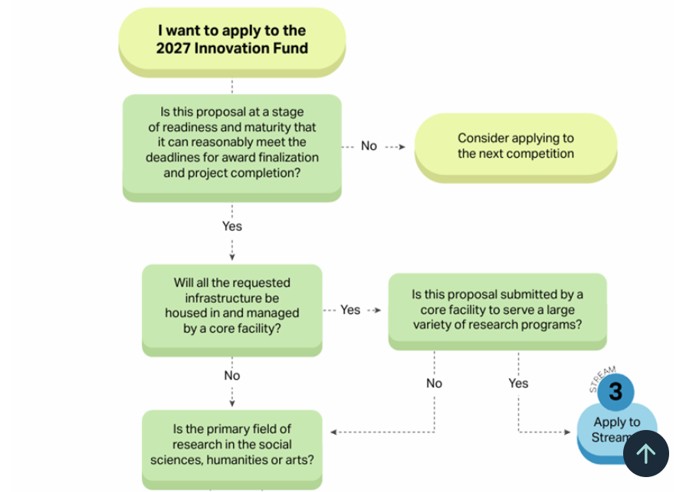
What counts as “official recognition from the institution” for a core facility?
Since different institutions have different approaches to core facilities, there are no explicit requirements for official recognition. We leave it up to institutions to determine which core facilities to formally recognize and the best way of doing so.
Can a proposal include multiple core facilities or distributed nodes?
Yes. The requested infrastructure may be located in multiple core facilities or a core facility with nodes across different locations.
Institutional envelopes and exemptions
If my institution applies its envelope exemption to a proposal whose primary field of research is in SSHA, are the contributions from collaborating institutions also exempted from their respective envelope allocations?
Yes.
Can my institution collaborate on more than one SSHA-exempted proposal?
Yes. There is no limit to the number of SSHA-exempted proposals an institution participates in as a collaborating institution. However, an institution may apply its own envelope exemption to only one (1) proposal for which it is the lead institution and whose primary field of research is in SSHA.
How does the CFI assess that an institution’s allocation of their envelope is proportional to its scientific contribution in multi-institutional projects?
We expect that an institution’s allocation of their envelope to a given project aligns with its role in the proposed activities, as outlined in the proposal. We conduct our assessment of proportional contributions holistically, taking into account the specific context of each case. If you’re unsure about the appropriateness of the envelope contribution distribution, contact us at innovation.fund [at] innovation.ca (innovation[dot]fund[at]innovation[dot]ca) for guidance.
Eligible costs
Can salary costs continue to be incurred after the infrastructure has been declared operational?
Yes. However, all expenses must be incurred between November 1, 2025, and the deadline to submit the final financial report, as outlined in the table below.
Project completion expectations
| CFI contribution to a project | Deadline to submit final financial report |
| ≤ $1 million | November 2031 |
| > $1 million and ≤ $4 million | November 2032 |
| > $4 million | November 2034 |
Can my institution submit a proposal that includes only salary costs for eligible personnel?
Yes.
Can my institution include the salary of a project manager in the budget?
Yes. It’s a particularly good idea to do so for complex projects.
Are community interface personnel costs limited to Stream 2 proposals?
No. Community interface personnel costs are eligible for all proposals whose primary field of research is in SSHA, regardless of what stream they are submitted to.
Can my institution include contingencies in construction budgets?
Yes. The budget can include, at most, a 10 percent contingency for construction (see section 4.6.2 of the CFI policy and program guide). You can also factor in projected inflation.
Is advanced research computing infrastructure eligible for funding?
Yes. Funding for advanced research computing infrastructure may be requested when it is relevant to carrying out a research project. However, proposals that focus predominantly on major, collective or shared advanced research computing infrastructure are not eligible. These advanced research computing needs are addressed through the Digital Research Alliance of Canada (Alliance).
We expect advanced research computing infrastructure costing more than $100,000 to be integrated into a national platform. Institutions should therefore consult the Alliance (CFI-FCI [at] alliance.ca (CFI-FCI[at]alliance[dot]ca)) before submitting notices of intent or proposals requesting advanced research computing infrastructure. We may share notices of intent and proposals of this type with the Alliance.
Does the CFI have a “buy Canadian” procurement policy?
No. We do not have a “buy Canadian” procurement policy but we encourage institutions to consider Canadian suppliers where appropriate. We recognize that research infrastructure depends on complex global supply chains. Institutions should procure the equipment and services that best meet the needs of the project.
Dual-use technologies and Department of National Defence collaboration
Do references in the call for proposals to mission-driven research or “areas that matter” introduce new requirements or affect how proposals are assessed?
No. We provide references to specific areas of research in the call for proposals to contextualize the current competition, but they do not represent new requirements for proposals. Proposals will be assessed against the objectives and assessment criteria of the competition. Proposals aligned with these areas will not be fast-tracked or receive preferential treatment in the review process.
How might the Department of National Defence (DND) be involved after notices of intent are submitted and during the review process?
Using public notice of intent information, DND may identify projects of interest. At its discretion, DND may contact institutions directly to explore collaboration opportunities. After obtaining appropriate permissions from the applicant institution, we may share notices of intent, proposals and Expert Committee reports with DND for projects of interest. In addition, during the review process, we may invite DND representatives to observe relevant Expert Committee meetings.
How should my institution address sensitive or classified information in the proposal while still making sure the proposal meets the assessment requirements?
Your institution must ensure that no sensitive or classified information is included in notices of intent or proposals. To the extent possible, and while respecting all applicable security restrictions, proposals should include sufficient information to address the assessment criteria. Where specific information cannot be disclosed for security reasons, applicant institutions should clearly indicate these limitations and provide brief explanations of the constraints.
Submitting notices of intent and proposals
Can my institution use artificial intelligence to develop a proposal?
If your institution chooses to use artificial intelligence to develop proposals, we encourage you to review and follow the Government of Canada’s Guidance on the use of Artificial Intelligence in the development and review of research grant proposals. Institutions are ultimately accountable for the complete contents of their proposal. Privacy, confidentiality, data security and the protection of intellectual property should be prioritized when developing and reviewing proposals.
Can a core facility director serve as a team leader?
Yes. A core facility director may create the notice of intent in CAMS, thereby becoming one of the project’s team leaders. The individual who creates the notice of intent must be affiliated with the applicant institution. This affiliation requirement does not apply to the additional team leader or other team members. This flexibility allows the assembly of the team best suited to deliver the project.
At what point after the notice of intent submission will the proposal module become available?
We will make the proposal module available once we have completed the administrative review of the notices of intent submitted. Institutions will be advised through CAMS once the proposal module is available.
Can an institution revise the team members between the notice of intent and the proposal?
Yes. To help us avoid conflicts of interest between review committee members and the proposals they are assessing, contact us at innovation.fund [at] innovation.ca (innovation[dot]fund[at]innovation[dot]ca) to inform us as soon as possible if you want to make a change to the team members after the notice of intent has been submitted.
Can an institution revise the requested research infrastructure between the notice of intent and the proposal?
Yes. Institutions should list the research infrastructure they are requesting as accurately as possible in the notice of intent to help guide our recruitment of expert reviewers. Contact us at innovation.fund [at] innovation.ca (innovation[dot]fund[at]innovation[dot]ca) as soon as possible to inform us of any substantial changes needed between the notice of intent and the proposal.
Are letters of support allowed in the proposal?
Letters of support are not required and may not be included as additional attachments. You may choose to include them within the assessment criteria PDF, but no additional space is provided.
How should team leaders and members describe non-academic contributions in their CV?
In addition to describing any relevant experience and expertise within the proposal when addressing the “Team” criterion, applicants may use the “Most significant contributions” section of their CV in CAMS to describe a wide range of research outputs and impacts. These may include open science practices, contributions to institutional policies, real-world societal contributions, industry collaborations, creative works, software or digital resources, knowledge mobilization activities, community engagement or other relevant outcomes. Consult the DORA Rethinking Research Assessment: Building Blocks for Impact toolkit for examples of diverse research contributions. All team members should ensure their CVs are up to date, as they will be appended to the proposal upon submission.
How should Stream 3 proposals address the “Research” criterion when they are expected to support a wide variety of research programs?
Stream 3 proposals are expected to support a variety of research programs. These proposals should demonstrate the innovative potential of a representative sample of projects that the core facility will enable. These examples should illustrate the range and potential impact of the requested infrastructure and may be framed around broader themes or services enabled by the facility. Given the broader scope and the need to reflect a diversity of projects, we will advise reviewers to expect higher-level descriptions of projects with scientific details on only a few of them.
Should salary costs for scientific and technical staff included in a Stream 3 proposal be reflected in the “Financial resources for operations and maintenance” section as well as in the “Cost of individual items” budget in CAMS?
Yes. If you are requesting funds to cover the salary costs of scientific and technical personnel dedicated to the operation and management of the core facility, this information should be reflected in two financial tables within CAMS to make it as clear as possible for reviewers:
1) In the financial table outlining the funding request (i.e., “Cost of individual items”); and,
2) In the “Financial resources for operations and maintenance” table, which outlines expected costs to maintain the core facility, including scientific and technical personnel dedicated to the operation and management of the core facility.
Review process
Can my institution request that certain individuals not be invited to review a proposal?
Yes. Contact us at innovation.fund [at] innovation.ca (innovation[dot]fund[at]innovation[dot]ca) as soon as possible if your institution would like to request that specific individuals not be invited to review a proposal.

How is my proposal assessed?
First, we make sure it is complete and adheres to our guidelines. Then, it is assessed through our review process.
1. Expert Committees
In the first stage of review, Expert Committees review small groups of proposals from the same area of research. Only proposals that meet a minimum threshold across the five assessment criteria will move to the Multidisciplinary Assessment Committees.
2. Multidisciplinary Assessment Committees
Multidisciplinary Assessment Committees review groups of proposals of similar size and/or complexity and assess them against the three competition objectives in order to:
- Identify proposals that demonstrate excellence and best meet the three competition objectives relative to other competing requests
- Provide a funding recommendation and funding amount for each proposal for the next stage of review.
3. Special Multidisciplinary Assessment Committee
In the third and final stage of review, a Special Multidisciplinary Assessment Committee (S-MAC) reviews reports from the MAC meetings for the proposals that the MACs recommend for funding. The S-MAC makes sure the MACs were consistent in their assessment. If recommendations from the MACs exceed the available budget, the S-MAC recommends to the CFI Board of Directors the proposals that best support the CFI’s mandate, meet the objectives of the competition and represent the most beneficial portfolio of investments for Canada.
What is the role of the Expert Committee?
Expert Committees play a key role in the CFI's review process. Find out what the committees do, and how their members are chosen.
At the Canada Foundation for Innovation, we invest in internationally competitive research and technology development.
This enhanced and optimized institutional research means ever increasing benefits for all Canadians in the social, environmental, economic and health sectors.
We provide funding to eligible Canadian institutions for equipment acquisition, technology development programs and the spaces needed to conduct world-class research, as well as support for their ongoing operations and maintenance.
For each of our various funding competitions, we invite institutions to submit project proposals that outline their research goals and the infrastructure they’ll need to reach them.
We then recruit experts from around the world to participate in our merit-review process.
Here’s how it works and what you – members of the expert committee – need to know…
First, we group proposals together, by research fields. Then we assign a committee of experts in those fields to provide assessments.
An expert committee is typically composed of a Chair and two to six members, depending on the number and breadth of proposals it will review.
The Chair ensures that the expert committee functions effectively and objectively in accordance with CFI policies.
As a member of the expert committee, your job is to review each proposal independently and submit individual assessments to the CFI before meeting with other committee members.
Using a five-point rating scale, you will need to judge how well each proposal meets the competition’s assessment criteria.
You will need to substantiate your ratings by listing the strengths and weaknesses you’ve identified for each criterion.
To help you properly assess the propositions according to the competition criteria, we encourage you to consult the guidelines for reviewers that can be found alongside the review material in CAMS and on our Innovation Fund website page.
We also ask that you comment on the appropriateness of the proposed budget.
This exercise allows you to identify key talking points that will help focus your committee’s discussion so you can reach a consensus.
If there are many proposals assigned to your committee, they may be divided up between members to ensure that every proposal gets thoroughly reviewed.
All materials necessary to make your assessments are available within two to three weeks of the submission deadline. They can be found in CAMS, our awards management portal.
You will need to activate the account we have created for you to gain access to these resources
Expert committees will meet virtually once or twice, depending on the number of proposals and a CFI representative will participate in every meeting.
With the members of your committee, you will be asked to reach a consensus on the strengths and weaknesses, and ultimately on ratings for each assessment criteria.
The CFI will then draft a report for each proposal outlining the expert committee’s conclusions and send them to the committee Chair for approval.
If a proposal meets the expert committee’s threshold of excellence, the proposal and the report will proceed to the Multidisciplinary Assessment Committee or MAC, for stage two of our merit review process.
At this stage, we regroup proposals based on the size of the applicant institution and the amount of infrastructure funding requested from the CFI.
Guided by the expert committee reports, MAC members are asked to evaluate proposals based on the competition’s objectives and recommend which projects to fund. Note that all funded projects will need to have received one of the top three marks from the MAC for the Team composition criteria.
If the number of proposals recommended by the MAC exceeds the competition’s available budget, a third committee, known as the Special Multidisciplinary Assessment Committee, or S-MAC, is responsible for narrowing down the choices.
The recommended proposals are then sent to the CFI Board of Directors
As you can see, the expert committees are the foundation of our valued merit review process.
Your expertise allows us to fund trailblazing projects with the greatest potential for impact — projects at the forefront of exploration and knowledge that address global challenges and make meaningful contributions to Canada’s social, health, environmental and economic development.
This enhanced and optimized institutional research means ever increasing benefits for all Canadians in the social, environmental, economic and health sectors.
We provide funding to eligible Canadian institutions for equipment acquisition, technology development programs and the spaces needed to conduct world-class research, as well as support for their ongoing operations and maintenance.
For each of our various funding competitions, we invite institutions to submit project proposals that outline their research goals and the infrastructure they’ll need to reach them.
We then recruit experts from around the world to participate in our merit-review process.
Here’s how it works and what you – members of the expert committee – need to know…
First, we group proposals together, by research fields. Then we assign a committee of experts in those fields to provide assessments.
An expert committee is typically composed of a Chair and two to six members, depending on the number and breadth of proposals it will review.
The Chair ensures that the expert committee functions effectively and objectively in accordance with CFI policies.
As a member of the expert committee, your job is to review each proposal independently and submit individual assessments to the CFI before meeting with other committee members.
Using a five-point rating scale, you will need to judge how well each proposal meets the competition’s assessment criteria.
You will need to substantiate your ratings by listing the strengths and weaknesses you’ve identified for each criterion.
To help you properly assess the propositions according to the competition criteria, we encourage you to consult the guidelines for reviewers that can be found alongside the review material in CAMS and on our Innovation Fund website page.
We also ask that you comment on the appropriateness of the proposed budget.
This exercise allows you to identify key talking points that will help focus your committee’s discussion so you can reach a consensus.
If there are many proposals assigned to your committee, they may be divided up between members to ensure that every proposal gets thoroughly reviewed.
All materials necessary to make your assessments are available within two to three weeks of the submission deadline. They can be found in CAMS, our awards management portal.
You will need to activate the account we have created for you to gain access to these resources
Expert committees will meet virtually once or twice, depending on the number of proposals and a CFI representative will participate in every meeting.
With the members of your committee, you will be asked to reach a consensus on the strengths and weaknesses, and ultimately on ratings for each assessment criteria.
The CFI will then draft a report for each proposal outlining the expert committee’s conclusions and send them to the committee Chair for approval.
If a proposal meets the expert committee’s threshold of excellence, the proposal and the report will proceed to the Multidisciplinary Assessment Committee or MAC, for stage two of our merit review process.
At this stage, we regroup proposals based on the size of the applicant institution and the amount of infrastructure funding requested from the CFI.
Guided by the expert committee reports, MAC members are asked to evaluate proposals based on the competition’s objectives and recommend which projects to fund. Note that all funded projects will need to have received one of the top three marks from the MAC for the Team composition criteria.
If the number of proposals recommended by the MAC exceeds the competition’s available budget, a third committee, known as the Special Multidisciplinary Assessment Committee, or S-MAC, is responsible for narrowing down the choices.
The recommended proposals are then sent to the CFI Board of Directors
As you can see, the expert committees are the foundation of our valued merit review process.
Your expertise allows us to fund trailblazing projects with the greatest potential for impact — projects at the forefront of exploration and knowledge that address global challenges and make meaningful contributions to Canada’s social, health, environmental and economic development.
What are the assessment criteria?
The assessment criteria for the 2027 competition are:
- Research
- Team
- Infrastructure
- Sustainability
- Benefits
See the call for proposals for details of each of these assessment criteria.


Want to grow your network, build your reputation and contribute to research?




Stories of research supported through the Innovation Fund

article
Prince Edward Island
Coastal scourge
Compounded by a changing climate, severe erosion is scouring Prince Edward Island’s coastline. Researchers are designing an elaborate coastal hazard monitoring and modelling system to help protect the island’s shores from being further flushed out to sea.


article
Quebec
Genetic sleuthing
A state-of-the-art laboratory is leveraging modern and ancient DNA analysis in tandem with genealogical data to fully understand an evolving population

article
Alberta
Probing the brain to break the cycle of opioid addiction
New treatments for opioid use disorder are desperately needed — and fast. The answer may lie in existing medications.

article
Quebec
Moving beyond surviving to thriving
A new network of eight Canadian universities aims to help make a difference for children and youth exposed to trauma

article
British Columbia,Manitoba
Unlimited access
Researchers combine expertise in engineering and occupational therapy to build wheelchairs that further break down barriers to mobility

article
Ontario
A fresh take on protecting our waters
A wide-ranging survey of aquatic environments in Eastern Ontario will bring together Indigenous and Western Knowledge to find better ways to preserve Canada’s freshwater habitats and species