The kelp found up and down B.C.’s coast may look like a humble sea vegetable. But the Seaweed Innovation Hub at Vancouver Island’s North Island College (NIC) sees an untapped resource.
Global demand for seaweed hit US$17B in 2021 as it expanded from food, pharmaceutical and cosmetic markets into building materials, bioplastics and a host of other novel uses.
At the Hub, researchers are exploring questions at every stage along the value chain. Which varieties are best suited for seaweed cultivation? What are the ecological impacts of kelp farming? Where do the commercial opportunities lie for B.C.’s emerging seaweed sector?
Since the Hub opened in 2013, it has become the go-to source for insights and access to cutting-edge research equipment.

“It just really exploded,” says Naomi Tabata, director of NIC’s Centre for Applied Research, Technology & Innovation. “The more we talked about this work that we were doing, the more potential partners came out of the woodwork and started to ask us for different seaweed-related initiatives.”
Many of them are First Nations. In some cases, they’re looking for the right species to restore natural kelp beds. In other cases, they want to expand their seaweed farms and explore market opportunities within Canada’s blue economy.
Others are local companies like Cascadia Seaweed, which produces a kelp-based soil supplement that boosts the yields of strawberries, tomatoes and other agricultural crops. Founded in 2019, the B.C. success story now employs two dozen staff, sells to farmers across North America and has attracted millions in investment dollars.
Supercharging kelp production
Today, the Seaweed Innovation Hub is helping Cascadia investigate ways to optimize kelp production using CFI-funded bioreactors from Victoria-based Industrial Plankton.
They’re testing how well these fully automated systems can provide kelp gametophytes — commonly referred to in industry as “seed” — on demand.
The bioreactors offer a controlled environment for seed storage, allowing businesses to respond to unforeseen crop production challenges. They can also serve as growth chambers to bulk up the seed volume in time for the growing season.
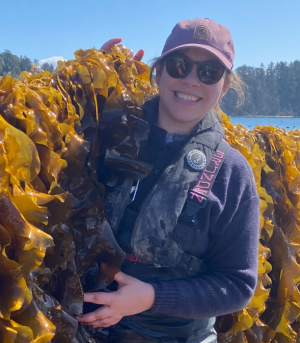
Initial results suggest the bioreactors can dramatically accelerate growth compared to traditional industry methods. This gives kelp farmers the volumes they need for commercial seaweed cultivation — and control over when to transfer it to the ocean farm — while reducing the amount of parent material they need to collect from wild kelp.
“It’s such a great innovation,” says Jennifer Clark, Cascadia Seaweed’s Chief Scientist. “We now have control of the genetic diversity. We have control of the density and how much seed we want to put on. And we can bulk this throughout the year.”
As a result, kelp farmers can extend the growing season from less than four months to six months or longer, a 50 percent gain.
Bolstering Canada’s blue economy
Thanks to government and private-sector partners keen to strengthen B.C.’s coastal economy and advance economic reconciliation goals with Indigenous communities, NIC has leveraged $200,000 in CFI funding into a staggering $3.6 million investment in the Seaweed Innovation Hub.
To catalyze further innovation, the college launched a hugely popular micro-credential program in seaweed production and processing in 2025, attracting entrepreneurial-minded students eager to enter the growing field.
And to help more companies mimic Cascadia’s success, NIC is convening researchers, First Nations, industry and other stakeholders to create a commercial roadmap for Pacific seaweed. They’re also working with colleagues in Quebec and Atlantic Canada to build a national seaweed industry network.
“It’s such an exciting sector, and I can’t wait to see what happens in five years,” says Tabata.

The research project featured in this story also benefits from funding from Mitacs, the Natural Sciences and Engineering Research Council of Canada and Pacific Economic Development Canada.