Just keep an eye on your inbox for a confirmation email.
Stay connected
Keep updated on:
Funding programs
Stories on cutting-edge research
Events... and more
Article
Advancing next-gen nuclear power
Corrosion research promises to make small modular nuclear reactors cheaper and safer than ever
Published
Institution(s)
University of Regina
Province(s)
Saskatchewan
Interview(s)
Arthur Situm
Assistant Professor, Tier 2 Canada Research Chair in SMR Safety and Licensing
University of Regina
Specializing in corrosion in small modular nuclear reactors
Steve Livingstone
Senior engineer
SaskPower
Specializing in small Modular Reactor development
People often ask
Q:
Are small modular reactors safe?
Arthur Situm: Yes, they are. The types of reactors we’re building are meant to operate under what’s called natural circulation, which means you do not need a diesel generator to keep the reactor safe in the case of some kind of large blackout scenario or large accident scenario. The reactor can run purely on the natural circulation of the coolant rather than depending on a diesel generator that has to turn on for the thing to be safe.
Summary
Because small modular nuclear reactors (SMRs) can be deployed in smaller energy grids and remote sites, they have a big part to play in Canada’s clean energy transition.
The better corrosion is controlled, the longer the reactor’s lifespan — ultimately reducing the costs of nuclear energy.
University of Regina research is exploring ways to do that, both for current SMRs and for next-generation models that use novel fuels and coolants.
Small modular nuclear reactors (SMRs)can play a key role in the energy future of Canada and the world. These units produce anywhere from a few megawatts of electricity (micro-SMRs) to a few hundred (grid-scale SMRs). They offer the same reliable, carbon-free energy as large-scale reactors, providing round-the-clock baseload energy that complements intermittent renewable energy.
However, they’re faster to build with lower up-front costs than a much larger traditional CANDU-sized reactor. And their smaller scale means they can be used in smaller energy grids, or even on remote, unconnected sites in the case of micro-SMRs.
That’s why Ontario, New Brunswick and Saskatchewan are all installing small modular reactors over the next decade. Saskatchewan is looking to build up to two 300-megawatt grid-scale SMRs, with the first to be up and running in the mid-2030s. The province is also evaluating the feasibility of large reactors and advanced SMRs to meet industry demand for electricity and heat.
Why is corrosion control crucial in nuclear facilities?
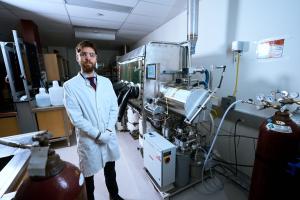
A custom glovebox coupled with a Raman spectrometer and probes allow Arthur Situm’s team to analyze molten salt reactions at temperatures up to 900°C. Elsewhere in the Small Modular Reactor Fuel Corrosion Lab, there are electrochemical workstations for corrosion testing and a high-temperature tube furnace and steam generator for testing materials under conditions analogous to a nuclear meltdown.
Chances are, Arthur Situm’s students at the University of Regina will be involved. The Tier 2 Canada Research Chair in SMR Safety and Licensing is investigating ways to control corrosion in current and advanced SMRs.
One issue his Small Modular Reactor Fuel Corrosion Lab is tackling is corrosion in conventional water-cooled reactors. If that cooling water leaks, a build-up of thermal energy could trigger high-temperature reactions that eat away the protective cladding encasing the nuclear fuel. So Situm’s team is developing fuel cladding materials better able to resist that corrosion.
They’re also looking at emerging SMR technologies that usemolten salt as a highly effective coolant, fuel or both. Over time, that salt creates a very challenging form of corrosion. “It actually slowly dissolves the metal, kind of like you’d see a sugar cube in water,” Situm explains. His team is investigating ways to add a sacrificial metal to the salt itself, postponing corrosion and therefore extending the life of the reactor.
A CFI-funded high-temperature glovebox combined with a Raman spectrometer allows them to study those molten salt reactions in real time. “To the best of my knowledge, [it’s] the only setup in the world right now in which that can be done while corrosion is taking place,” Situm says.
Finally, the researchers are examining whether those salts could be converted to a ceramic that will resist corrosion in the deepgeological repositories that will eventually hold Canada’s nuclear waste.
By the numbers
300,000
Content
Estimated number of homes one 300-megawatt small modular reactor can power for a year
$150B+
Content
Estimated annual global market for small modular reactors by 2040
At the forefront of nuclear innovation
Although advanced SMRs that use coolants other than water are still in the R&D stage, they’re something SaskPower — Saskatchewan’s main electricity utility — could be eyeing down the line. That makes Situm’s lab a major asset. “When we get towards thinking about those advanced reactors, he’s the expertise in the province that we can talk to,” says SaskPower Senior Engineer Steve Livingstone, who has partnered with Situm on his research.
Meanwhile, a $7 million Small Modular Reactor Safety Licensing and Testing Centre expected to open in 2027 or 2028 will complement the university’s existing nuclear research strengths and equipment, including Situm’s lab. Together, these facilities will attract additional talent and put Saskatchewan at the forefront of SMR technology — a global market estimated to hit $150 billion a year by 2040, according to Canada’s Small Modular Reactor (SMR) Action Plan.
“The leading edge of greenfield new nuclear is here in Saskatchewan,” Livingstone says.
Author: Julie Stauffer heads up Cadmium Red Communications, a boutique writing and editing agency that specializes in sustainability, engineering and health issues.
With a few creative hacks, the Flux Lab has transformed a lab bench gas analyzer into a mobile tool they’re using to measure emissions from pipeline leaks, landfills and melting permafrost in the field
Could “DNA origami” offer a way to store some of the world’s 149 trillion gigabytes of information and help solve big data’s big storage problem? At UBC Okanagan, Will Hughes is exploring the possibilities.