Just keep an eye on your inbox for a confirmation email.
Stay connected
Keep updated on:
Funding programs
Stories on cutting-edge research
Events... and more
Article
Quantifying carbon capture in Canadian wetlands
Measuring the power of peatlands, swamps and marshes to sequester carbon and slow climate change
Published
Institution(s)
McGill University
Province(s)
Quebec
Interview(s)
Sara Knox
Associate professor and geography researcher
McGill University
Specializing in biosphere-atmosphere interactions
Kelly Bona
Research scientist
Environment and Climate Change Canada
Specializing inquantifying greenhouse gas emissions and removals from wetland land-use change
People often ask
Q:
How does draining a wetland release greenhouse gases?
Sara Knox: When you drain a wetland, you expose all of the carbon-based material that was underwater and therefore slowly decomposing to oxygen. Under drained conditions, the microbes that are in there in the soil can then decompose the organic material much faster and release it as carbon dioxide to the atmosphere. The carbon that was locked away gets released.
Summary
Canada’s wetlands absorb and store carbon dioxide from the atmosphere. But we’re lacking data on how that fluctuates across seasons and how much carbon wetlands emit when they are disturbed.
To fill those gaps, McGill University earth system scientist Sara Knox is deploying permanent and portable monitoring stations to measure carbon dynamics in Quebec wetlands.
Those insights can improve the accuracy of Canada’s national greenhouse gas inventory, identify which wetlands are most important to conserve and boost the credibility of carbon markets.
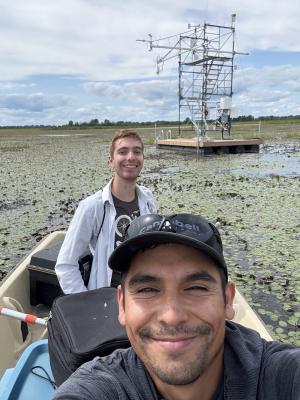
At a marsh near Nicolet, Que., McGill graduate student Dylan Gwilliam (back) and CARBONIQUE lead technician David Trejo (front) pose in front of an “eddy covariance tower” that measures the exchange of greenhouse gases, water and energy between wetlands and the atmosphere. Now, portable versions of the technology — funded by the CFI — are unlocking new tracking opportunities.
Wetlands are one of the world’s most carbon-dense terrestrial ecosystems, drawing planet-warming carbon dioxide from the atmosphere and storing it for centuries or even millennia. That makes Canada’s abundant peatlands, swamps and marshes powerful tools in the fight against climate change.
But exactly how much carbon do these ecosystems capture? And how does that change when they’re drained or disturbed — whether it’s for agriculture, housing developments, oil sand operations or mining in Ontario’s peatland-packed Ring of Fire?
According to the federal 2030 Emissions Reduction Plan, nature-based climate solutions have significant potential to contribute to Canada’s decarbonization goals — and provide many other benefits. However, Canadian wetland data is scarce, says Bona: “We know they store a lot of carbon, and we know when we disturb them that they emit a lot of carbon, but we don’t actually have good values.”
The equations are also complicated. Plants take up carbon through photosynthesis during the day and store it in their biomass. But they also release some of it through respiration. They sequester more carbon in the summer, when plants are active, and less in winter. And wetlands contain anaerobic microbes that generate methane — a potent greenhouse gas — when they break down organic material, offsetting some of the carbon storage benefits.
How do researchers track the complexities of wetland carbon dynamics?
McGill University scientist Sara Knox is helping fill in the blanks and understand those complexities through the CARBONIQUE study: the largest and most comprehensive assessment of wetland carbon dynamics in Canada. Her team at the EcoFlux Lab and her CARBONIQUE colleagues have installed permanent monitoring towers in natural and disturbed wetlands across southern Quebec to track carbon dioxide, methane, water and energy exchanges between the land and atmosphere.
“We can actually quantify fluxes, that direct measurement of carbon in and out of our ecosystems,” explains Knox.
While the towers provide valuable long-term data, they are expensive, time-consuming to install and fixed in place. So Knox’s team is alsodeploying new portable monitoring stations funded by the CFI to gather data from a range of sites and to monitor the impacts of droughts or flooding as they happen.
“This infrastructure allows us to leverage what we already have and answer new questions we couldn’t have addressed otherwise,” says Knox.
This summer, for example, the team installed a portable station in a drained, agricultural peatland and will compare its measurements with those from a natural, undrained peatland nearby to see how draining changes a bog’s carbon balance.
By the numbers
78 megatonnes
Content
Estimated CO2 emissions that Canada could avoid or remove through nature-based solutions in 2030
20%
Content
Proportion of those reductions that wetlands could provide, based on currently available data
How does better wetlands data support climate action?
The preliminary CARBONIQUE findings are already providing a more nuanced understanding of wetlands as nature-based climate solutions. Those insights can help identify which wetlands are most important to conserve or restore for their climate benefits. They can also ensure the carbon credits bought and sold on private markets accurately reflect emissions reductions.
Back at Environment and Climate Change Canada, Bona is using the data to help Canada track its emissions and inform good climate policy. “If we’re going to have climate-adaptive strategies to mitigate our impact on the land, then we need to be able to better track that impact,” she says. “So the data is very valuable.”
Author: Julie Stauffer heads up Cadmium Red Communications, a boutique writing and editing agency that specializes in sustainability, engineering and health issues.
With a few creative hacks, the Flux Lab has transformed a lab bench gas analyzer into a mobile tool they’re using to measure emissions from pipeline leaks, landfills and melting permafrost in the field
By profiling tailpipe emissions and creating community-specific transportation models, researchers will help cities reach their net-zero mobility goals faster — even in sub-zero temperatures