Few people know this, but hidden away in the austere Paul-Comtois building at Université Laval in Quebec city is a cheesemaking operation. In the basement of the south wing, a plain, 20-by-20-foot room houses two small curdling vats and an unusual, cube-shaped, stainless-steel machine. “This is our press,” says Julien Chamberland, an associate professor in the food science department at Université Laval. “It came straight from Italy. It’s helping us explore the secrets of mozzarella.”
Chamberland is a cheese enthusiast who talks about his research the way chefs talk about their recipes: with gusto!

Standing next to “his” press, Chamberland explains: “Mozzarella is a stretched-curd cheese. After the milk curdles, the curd needs to be mixed and kneaded at high temperatures until it reaches the right stretchy, sticky texture. Some artisanal cheesemakers do this step by hand, but it can also be done on an industrial scale using specialized equipment.”
That’s why Chamberland obtained this machine, which is the size of a large refrigerator and takes pride of place in the room, studded with buttons and tubes. Acquired with funding from the CFI, the machine allows for better control over the composition of finished products. As a result, it has the potential to boost the efficiency and competitiveness of Quebec’s $3 billion cheese industry.
Overcoming the uncertainties of cheese production
Each cheese has its own specific characteristics. In the case of mozzarella, it must be stretchable, melt at a specific temperature, retain fat during cooking, and balance the potential to brown with the ability to remain white when cooked. Cheesemakers must deliver a consistent product, which is no easy feat when the composition of the milk varies depending on the season and the cattle’s diet.
When produced, the curd used to make mozzarella starts out loose and crumbly. It’s then fed into the top of the machine, where two horizontal extrusion screws knead it while steam keeps its temperature between 65°C and 70°C. This lines up the molecules of casein (the main protein in cheese) to form a smooth, shiny, highly stretchy, malleable mass. As the mass is stretched, it takes on the fibrous texture typical of mozzarella.
“Depending on the acidifying starter or coagulant, the level of acidification, the curd’s moisture and fat content, and other adjustable variables, the resulting cheese can be moist and soft or dense and firm,” says Chamberland. “The best thing about the machine is that it can be configured in many different ways, acting as a testing ground to help us understand the effect of operational variables on the final product.”
Quebec, Canada’s cheese champion
Canada produces roughly 450,000 tonnes of cheese per year, with just over half of that coming from Quebec. And nearly half of Quebec’s production — just over 100,000 tonnes — is mozzarella, which is primarily used for pizza. “A billion litres of milk is used every year just for Quebec mozzarella,” says Chamberland.
For many large companies, mozzarella is their flagship product. So, they welcome any advancement that increases yield, minimizes losses, speeds up the process, reduces production costs, or improves the product’s environmental footprint. “Facilities like ours and machines like this one allow us to do that,” Chamberland says. “We make small batches, so we have more freedom and flexibility to conduct trials under new conditions, adjust settings, and experiment. In short, we’re trying to help the industry become more competitive.”
Cheesemakers in training
A small team of students heads down to the basement and puts on lab coats. They’re La fromagerie du campus, a student committee that makes cheese three or four times a semester and sells it to the university community. Cédric Nolet, a fourth-year student, is the committee’s director of research and development. “Our bachelor’s degree in food science and technology lacks hands-on work. Getting involved in this committee lets us get our hands dirty and make up for that.”
The cheesemaking machine allows these students to produce new types of cheese and tap into new markets. “The first time we used it to make mozzarella, we were so happy,” Nolet says. “We handed out fresh mozzarella to everyone in the department!”
A highly sought-after workforce
Some students find their calling at La fromagerie du campus. “I know several former students who completed the cheesemaking program and now work in the industry,” says Nolet. That’s fortunate because both large and small cheese factories are facing severe labour shortages.
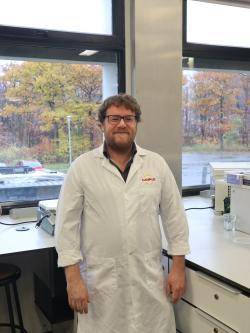
Chamberland, who was a member of La fromagerie du campus 10 years ago while earning his bachelor’s degree, wasn’t necessarily headed for a career in cheese at first. “I caught the cheesemaking bug while travelling through Europe — that’s where I discovered the craft,” he says. “I’m currently one of a handful of researchers in Canada working in this field. Yet there are so many mysteries to solve, flavours to invent, and discoveries to apply on a large scale to make the industry more sustainable.”
The research project featured in this story also benefits from funding from Quebec’s Ministère de l’Économie, de l’Innovation et de l’Énergie.